VIETNAM CHAMBER OF COMMERCE AND INDUSTRY
Liên Đoàn Thương Mại Và Công Nghiệp Việt Nam
Wed, Nov 11, 2026, 15:54:00
The talks took place as part of the Vietnamese top leader’s official visit to Japan.
Takaichi affirmed that Vietnam plays an important role in Japan’s efforts to diversify and upgrade its supply chain networks. Japan would create favorable conditions for Vietnamese businesses to participate more deeply and substantively in Japanese companies’ supply chains, she said.
Japan was also ready to cooperate with Vietnam in ensuring energy security and energy reserves, and accelerating the implementation of LNG-fired power projects in Vietnam under the POWERR Asia initiative, Takaichi added.

In response, Lam affirmed that Vietnam consistently regards Japan as one of its most important strategic partners and a sincere, trusted friend in pursuing sustainable development goals. Vietnam supports Japan in playing a proactive role in the region and the world, as well as successfully implementing its new growth strategy, he said.
The two leaders noted that the Vietnam-Japan Joint Vision Statement provides an important foundation for elevating their Comprehensive Strategic Partnership to a new level, with the two countries serving as partners in cooperation, co-creation and mutual benefit, towards high-quality growth, strategic autonomy and resilience.
Lam and Takaichi reviewed bilateral ties and expressed satisfaction with their comprehensive, substantive and effective development since the relationship was upgraded to a Comprehensive Strategic Partnership in 2023. They also welcomed progress in implementing nearly 80% of the commitments and agreements reached between the two sides.
On economic cooperation, the two leaders agreed to strengthen economic connectivity to ensure economic security and enhance strategic autonomy. They also agreed to promote high-quality Japanese investment in Vietnam, accompanied by technology transfer and training of highly skilled workers, and advance next-generation ODA cooperation in areas such as artificial intelligence, semiconductors, energy, digital transformation and the green transition. The two sides also agreed to promote large-scale, high-quality infrastructure development projects in Vietnam.
Lam welcomed the signing of an agreement to facilitate the implementation of Japanese grant aid projects in Vietnam. He called on both sides to ensure the timely commencement of the Vietnam-Japan University and Cho Ray Hospital projects, and work closely together to raise bilateral trade to $80 billion by 2030.
The two leaders agreed to advance science, technology and innovation cooperation based on partnership, co-creation and public-private collaboration. They also agreed to promote cooperation in space technology, maritime and ocean affairs, AI, digital technology, semiconductors, medical technology, advanced biotechnology, high-tech agriculture and strategic minerals.
The two sides will continue to expand joint research projects and AI cooperation, while extending the acceptance of doctoral researchers under the NEXUS program to semiconductors and AI. They also agreed to effectively implement 14 projects under the Joint Crediting Mechanism (JCM).
Lam proposed establishing a network of scientists in six fields: robotics, semiconductor chips, energy technology, biotechnology, high-speed rail and quantum technology.
The Japanese prime minister affirmed that Japan would actively support Vietnam by contributing to the country's plan to train 100 AI PhD holders.
Takaichi pledged Japan's support for Vietnam in successfully hosting APEC Year 2027 and expressed her hope to visit Vietnam again soon.
Japanese firms urged to invest in smart infrastructure, green energy
On the same day, Lam met and held discussions with executives and representatives of major Japanese corporations affiliated with the Japan Business Federation (Keidanren) and the Japan Chamber of Commerce and Industry in Tokyo.
He called on Japanese corporations to expand cooperation with Vietnam beyond manufacturing and trade to joint technology research, product design and development, including in artificial intelligence, green energy and smart infrastructure.
Lam said the two sides should transform their relationship from “traditional cooperation based on receiving and transferring technologies” into “co-creation partnerships with deeper integration into value chains and supply chains”, with a view to achieving high-quality growth and strengthening strategic autonomy for the prosperity of both countries.
He urged Keidanren members to view Vietnam not merely as a manufacturing base or consumer market, but as a long-term strategic partner for joint product development, testing new business models and advancing strategic technologies.
He highlighted opportunities to jointly develop a high-tech industrial ecosystem, cooperate in semiconductors and AI, build large-scale data centers, and develop AI solutions.

At the Vietnam-Japan Public-Private Forum on Economic and Science-Technology Cooperation held the same day, Lam called for stronger cooperation in research, product development and technology commercialization.
He encouraged the establishment of joint research centers, laboratories and technology development programs linked to manufacturing needs and market demand.
According to Lam, economic cooperation is a key pillar of the Vietnam-Japan Comprehensive Strategic Partnership, while science, technology and innovation are increasingly emerging as new drivers of growth.
He said the two countries had launched joint semiconductor research initiatives in 2026, and called for priority cooperation in areas with strong potential and shared benefits, including AI, semiconductors, biotechnology, clean energy and smart industries.
Lam urged Japanese companies to expand high-quality investment in Vietnam and strengthen partnerships with Vietnamese businesses in research, design, supporting industries, smart manufacturing and management capacity building.
Vietnamese companies, in turn, were encouraged to proactively improve their technological capabilities, product quality and management standards to gradually take on higher value-added activities.
At the meeting with Japanese corporations, To Lam called on businesses to consider investing in smart infrastructure systems, green energy projects, green logistics and green industries. He also urged them to work with Vietnam on emissions-reduction technologies and solutions to ensure energy security at reasonable costs while maintaining the economy's competitiveness.
He also identified finance and banking, capital markets, high-tech healthcare, pharmaceuticals and bio-industries as potential areas for cooperation.
Regarding the investment environment, Lam said Vietnam was committed to continuing to review and streamline administrative procedures, address institutional bottlenecks, and protect investors' legitimate rights and interests.
The country would also ensure an adequate and stable supply of electricity and water, telecommunications infrastructure, cleared land and human resources, he said.
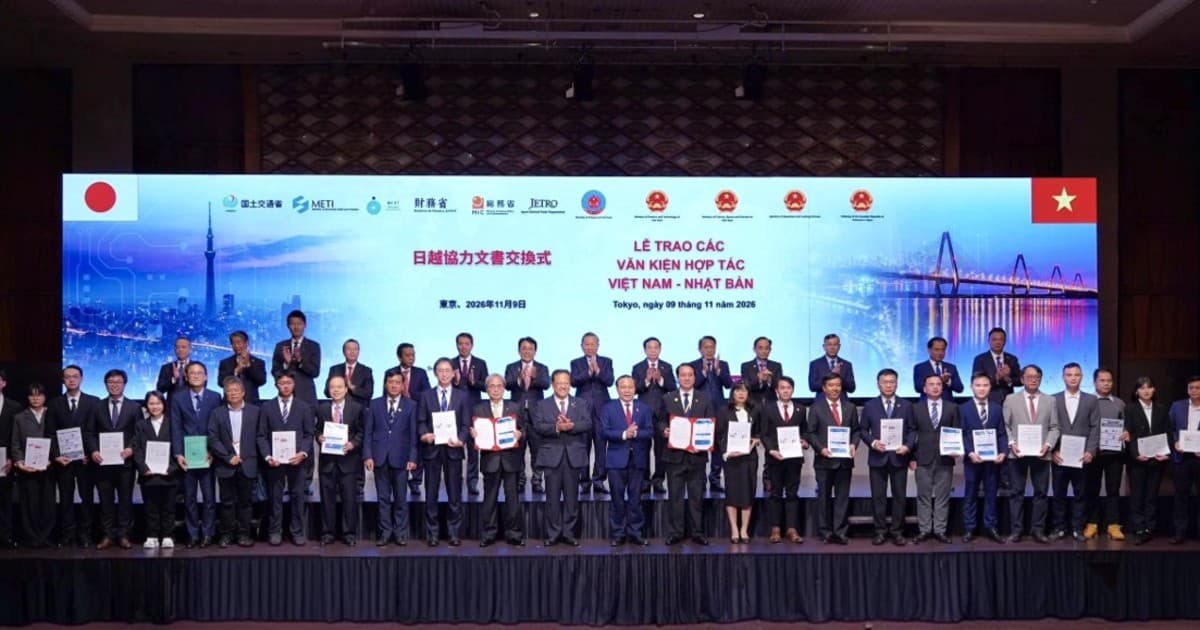
At the public-private forum, Lam and the Vietnamese high-level delegation witnessed the exchange of cooperation documents between businesses and government ministries and agencies from the two countries.
The agreements covered information technology, AI and semiconductors; energy and the green transition; education and training, scientific research; healthcare; finance and banking, aviation and investment; as well as agriculture, smart transport and logistics.
To Lam said the results of Vietnam-Japan cooperation in the coming period should be measured by the technologies developed, products created, businesses growing together and generations of highly skilled workers trained.
Vietnam and Japan have extended most-favored-nation tariff treatment to each other since 1999. According to Vietnam's Ministry of Foreign Affairs, bilateral trade reached approximately $52 billion in 2025, up around 11% from 2024 and nearly double the $27.4 billion recorded in 2014.
In the first nine months of 2026, bilateral trade totalled $43.71 billion, up 15.34% year-on-year. Vietnam exported $23.18 billion worth of goods to Japan and imported $20.53 billion.
Vietnam's major export categories to Japan include textiles and garments, transport vehicles and spare parts, machinery and equipment, phones and components, computers, electronic products and components, and wood and wooden products.
In the opposite direction, Vietnam imports computers, electronic products and components, machinery, equipment and spare parts, as well as iron and steel, automobile components and chemicals from Japan.
In terms of investment, Japan had approximately 5,872 active projects in Vietnam as of the end of September 2026, with total registered capital exceeding $81 billion, ranking third among countries and territories investing in the country. Japanese investment commitments reached $2.65 billion in the first nine months of 2026 alone.
At the November 9 meeting, Keidanren representatives expressed their hope that Vietnam would continue improving the quality of its investment environment, strengthening bilateral cooperation mechanisms and promoting its role in safeguarding supply chains and maintaining free trade.
Representatives of Japanese corporations also shared updates on their investment and business operations in Vietnam and outlined potential areas for cooperation, including technical workforce training, infrastructure development, energy and digital transformation.
As part of his official visit to Japan, Party General Secretary and State President To Lam and Japanese Prime Minister Takaichi Sanae witnessed the exchange of nine Vietnam-Japan cooperation documents in Tokyo on the evening of November 9 (local time), following their talks. A total of 11 documents had been signed.
The documents signed include:
1. A framework agreement on facilitating the implementation of Japanese grant aid projects in Vietnam.
2. A loan agreement with the Japan International Cooperation Agency (JICA) for the construction of the O Mon 3 thermal power plant.
3. An exchange of notes (E/N) with Japan on official development assistance (ODA) loans for the construction of Vietnam-Japan University.
4. The Vietnam-Japan Technical Cooperation Program for fiscal years 2025-2026.
5. An agreement between the Vietnamese government and the Japanese government on the development of Vietnam-Japan University in Vietnam.
6. A memorandum of understanding on cooperation in the field of nuclear power.
7. A cooperation agreement between Vietnam's Ministry of Science and Technology and Japan's Ministry of Education, Culture, Sports, Science and Technology on joint research and development in artificial intelligence.
8. A memorandum of understanding between Vietnam's Ministry of Agriculture and Environment and the Cabinet Office of Japan on cooperation in maritime and ocean policy.
9. A memorandum of understanding between Vietnam's Ministry of Agriculture and Environment and Japan's Ministry of the Environment on environmental cooperation.
10. An agreement on “Further improving the quality and effectiveness of legal development and implementation in Vietnam” for the 2027-2030 period, funded by JICA.
11. A memorandum of understanding between Vietnam's Intellectual Property Office under the Ministry of Science and Technology and the Japan Patent Office on accelerated patent examination.