VIETNAM CHAMBER OF COMMERCE AND INDUSTRY
Liên Đoàn Thương Mại Và Công Nghiệp Việt Nam
Tue, Mar 01, 2022, 11:17:00
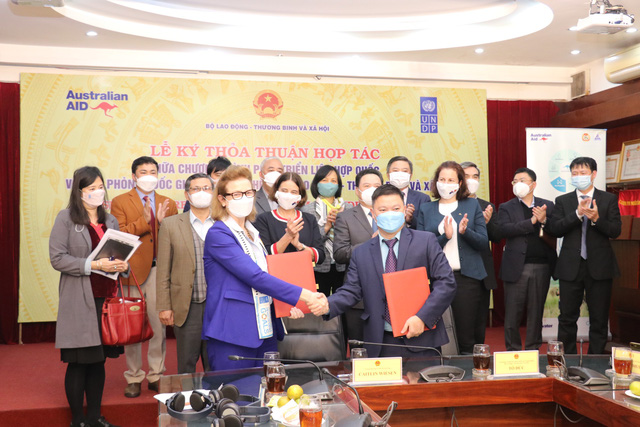 UNDP Resident Representative in Viet Nam Caitlin Wiesen and Deputy Minister of Labor, Invalids and Social Affairs Le Van Thanh sign the memorandum of understanding on cooperation in sustainable poverty reduction, Ha Noi, February 28, 2022 - Photo: VGP/Thu Cuc
At the signing ceremony, Deputy Minister of MOLISA Le Van Thanh highly appreciated cooperation in the field of poverty reduction of UNDP, the Australian Department of Foreign Affairs and Trade (DFAT), and the National Office on Poverty Reduction.
The MOLISA looks forward to strengthening bilateral and multilateral cooperation with international partners to successfully implement the objective of reducing multidimensional poverty in a inclusive and sustainable manner, toward reducing poverty in all dimensions, for all people, noted Le.
The Program has many more innovative core points in relative to the 2016-2020 period. The new Program applies a strategy to focus investment in people, with direct investment in developing capacity for the poor. It clearly identifies the causes of poverty in order to radically and thoroughly solves the problems of the poor and the extremely poor areas.
The Program deploys investment with focus and sustainability, focusing on poor districts and communes with special difficulties in coastal areas and islands. Priority is given to supporting poor ethnic minority households, poor households with members providing meritorious services to the Revolution, and children and women from poor households.
It also focuses on supporting the poor to solve the most critical issues such as livelihoods, vocational training, employment, and stable income.
This project demonstrates the commitment from UNDP to support MOLISA in their vision to deliver the National Targeted Program on Sustainable Poverty Reduction (NTP), said UNDP Resident Representative in Viet Nam Caitlin Wiesen.
The UNDP's tried and tested innovative solutions will be applied more widely to help meet the NTP's objective of reducing the number of poor and near-poor households by half by 2025, she added.