VIETNAM CHAMBER OF COMMERCE AND INDUSTRY
Liên Đoàn Thương Mại Và Công Nghiệp Việt Nam
Sat, Jun 13, 2020, 10:15:00
After forming in the East Sea late on June 12 Typhoon Nuri is rapidly gaining strength and is on course to make landfall in southern China on June 14, triggering heavy downpours and rough seas in local areas, including the north of the country.
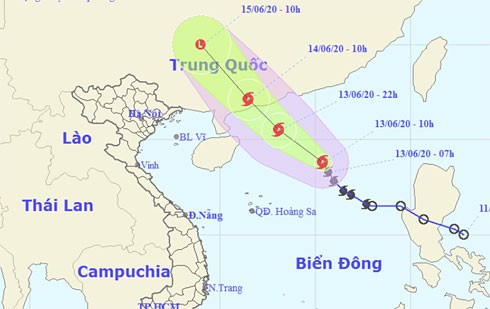
Typhoon Nuri is forecast to make landfall in southern China,
but cause heavy downpours and rough seas on its path
According to the National Centre for Hydro-Meteorological Forecasting, the typhoon was located approximately 400km north-east of Vietnam’s Hoang Sa archipelago at 10am on June 13, with winds of 75kph close to its centre.
Over the course of the next 12 hours, the typhoon is anticipated to move north-west at a speed of 25kph and is likely to further strengthen. By 10pm on June 13, Typhoon Nuri is forecast to be situated roughly 200km south-east of China’s Guangdong province, with maximum winds reaching 90kph at the eye of the storm.
With the weather pattern expected to make landfall early on June 14, Nuri is likely to lose much of its strength and turn into a tropical depression.
Nuri is expected to cause rough seas locally, in addition to seeing a downpour of heavy rain hit the northern part of the East Sea, including the Hoang Sa archipelago.
The National Steering Committee for Natural Disaster Prevention and Control and the National Committee for Disaster Response, Search and Rescue has therefore sent a telegram to the Command Board for Natural Disaster Prevention and Control, Search and Rescue of provinces and ministries.
The message asks them to provide regular updates on any developments, whilst informing vessel owners operating at sea about the path of the typhoon so that they are able to avoid any danger areas.
Localities and ministries have been requested to make regular and direct contact with vessels operating in danger areas, therefore being ready to carry out any rescue work upon request.
The Ministry of Foreign Affairs shall therefore be proactive in contacting relevant countries and territories in an effort to create shelter conditions for vessels and fishermen in case of emergency.
Though typhoon Nuri will not directly hit Vietnam, it is forecast to cause heavy rain in northern and central-coastal provinces. Moreover, northern mountain localities have been warned of possible landslides and flashfloods.
With the imminent arrival of heavy rain brought about by the typhoon, the ongoing two-week long heat wave, the longest in the past 27 years, is expected to end in northern and central Vietnam on June 14.