VIETNAM CHAMBER OF COMMERCE AND INDUSTRY
Liên Đoàn Thương Mại Và Công Nghiệp Việt Nam
Tue, May 19, 2026, 16:00:00

The US dollar remains on the front foot, and this is expected to continue in the short term.
The US dollar remains on the front foot, and Steven Barrow, Head Strategist of the Standard Bank, expects this to continue in the short-term. “We are targeting euro/dollar to break modestly below the bottom of the 1.14-1.21 range that has been in play since last summer. We are also looking for dollar/yen to move above the 160 level that the Japanese authorities seem so key to defend”, said Steven Barrow.
In fact, of all the currencies, it seems that the yen is the key one right now. This is not just because the yen is weak and near levels that the Japanese authorities clearly find uncomfortable; it is because the bond market is so weak as well.
Many analysts have ever argued that interest rates can become particularly volatile if the central bank is trying to pin the currency down to a certain level or a certain target range. They see this most often with fixed exchange rate mechanisms. But here the interest rate volatility tends to occur at the very front end of the interest rate market. This is because the central bank – or the market – engineers a very steep rise in overnight rates in order to make shorting the currency very expensive when it falls to the weakest part of the permitted band.
Japan does not have a fixed currency system and hence the BoJ is not forcing prohibitively high rates at the very front end of the curve. Instead, the bond market is creating the pressure and much of this is felt at the very long end of the curve. Now clearly the country’s poor fiscal metrics are also a factor here, but there’s little doubt in our mind that the authorities attempt to frustrate yen weakness is spilling over into bond market duress. The BoJ can keep on intervening, but there could come a point here where others, notably the US, have to help out. If surging JGB yields infect other bond markets, such as treasuries, then this becomes a problem for the US Administration, not just Japan. We saw in the spring of last year that the Administration can be very sensitive to weakness in the treasury market.
Back then the shocking liberation-day tariff announcement in April upended financial markets, forcing the president to declare a three-month pause in the tariffs in order to calm the “yippy” bond market as he termed it. That move eased the pressure on treasuries and tariffs went ahead. Fast forward to today, and it seems very conceivable that the US authorities may have to intervene in the yen, possibly in coordination with other G7 nations in order to avoid excessive yen weakness and prevent a crisis in government bond markets. “While we do have a forecast for dollar/yen to push past 160, we also see a longer-term pullback in the dollar; something that could be initiated by US intervention," emphasized Steven Barrow.
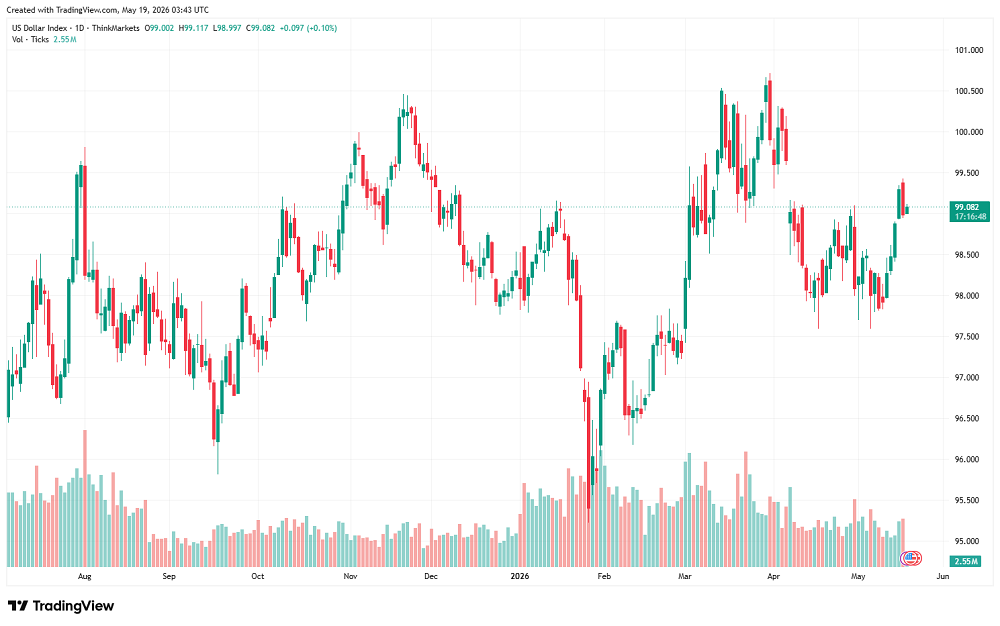
USD index is moving sideways
Another G10 country that could prove vulnerable to currency weakness is the UK. The economy starts from a weak place, will be hit harder than its peers by the surge in energy prices, and now faces the prospect of a debilitating leadership election for the post of Prime Minister. Importantly, some of those looking to take over from PM Starmer, such as Manchester Mayor Andy Burnham, have a notably different agenda in mind to the one being currently followed.
We saw back in September 2022 how a different agenda at the top of politics can crater financial assets, including the pound. Back then it was the injudicious mini-budget from new PM Liz Truss that hit the pound. That budget marked a huge shift to the right within British politics but failed spectacularly, and Truss left office after just 44 days. The Labour Party leadership election that seems likely in coming months could see a notable shift to the left.
“We do not expect that any such shift will lead to the same degree of weakness that we saw in September 2022, as that crisis was dramatically enhanced by strains in a sector of the UK pension market that have since been corrected. But be in no doubt that sterling still risks notable weakness and we’ve pushed our sterling/dollar forecasts down into the 1.25-1.30 range to take account of these risks”, forecasted Steven Barrow.