VIETNAM CHAMBER OF COMMERCE AND INDUSTRY
Liên Đoàn Thương Mại Và Công Nghiệp Việt Nam
Thu, Aug 14, 2025, 08:24:00
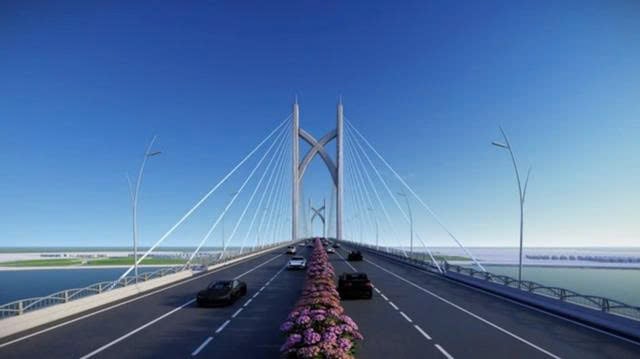
In its proposal to the municipal People's Committee, Trungnam Construction Investment JSC, a subsidiary of Trungnam Group, suggested to build the bridge under the build-transfer (BT) model, instead of the previously planned build-operate-transfer (BOT) approach.
Trungnam Group had earlier received approval from the city to conduct a feasibility study for the project. Its proposal was submitted to the People's Committee and used by the former Department of Transport as the basis for documentation presented to the municipal People's Council in late 2023.
Previously, the project was proposed under the BOT model, to be implemented between 2024 and 2028. However, according to Trungnam, the Prime Minister's Decision No. 1125 (dated June 11, 2025) approved the inclusion of Metro Line No. 12 (District 7-Can Gio) in HCMC’s urban transport master plan, with construction expected to begin in 2026.
This new metro line alters the region’s transport structure, making a BOT model unsuitable due to anticipated low traffic volume, extended payback period, and toll collection potentially affecting residents’ basic right to mobility.
As a result, Trungnam proposed shifting to the public-private partnership (PPP) model, aiming to optimize financial efficiency, reduce environmental impact, and better suit local conditions. The group also committed to full support from design to construction, ensuring quality and timely delivery.
Trungnam Group is known as a diversified conglomerate, primarily active in five sectors: energy, infrastructure and construction, real estate, and electronics. The group has invested in large-scale renewable energy projects such as the Trung Nam Thuan Nam solar power plant (VND12 trillion or $457.1 million), the Ea Nam wind power project (VND16.5 trillion), and the Trung Nam-Tra Vinh wind power project through subsidiaries like Trung Nam Thuan Nam Solar Power Co., Ltd. and Trung Nam Renewable Energy JSC.
Alongside Trung Nam, major real estate developer Masterise has also expressed interest in investing in the Can Gio Bridge via the BT model. The company affirmed its readiness to collaborate with HCMC to develop critical transport infrastructure linking the southeastern region.
Meanwhile, another private firm Thaigroup has proposed engaging in the project under either a BT contract or another suitable investment method.
Although not much public financial data is available on Thaigroup, insights can be inferred from the performance of Thaiholdings JSC – a Hanoi-headquartered multi-sector investment company that previously held a major stake in Thaigroup.
Thaiholdings (THD) once held nearly 82% of Thaigroup’s shares before reducing its stake to 48% in 2024. In in the first half of this year, it reported revenue of VND554 billion ($21.1 million), up 6% year-on-year, and pre-tax profit of VND62.2 billion ($3.27 million), up over 5%.
Thaigroup also garnered media attention in late 2021 when it proposed a nearly VND30 trillion ($1.14 billion) space tourism project in Phu Quoc.
Dai Quang Minh Real Estate Investment JSC (Thadico) of billionaire Tran Ba Duong has proposed the People's Committee of Dong Nai province to allow it to prepare project documentation for the construction of a new road connecting Dong Xoai to HCMC’s Ring Road 4 via Provincial Road 753, Ma Da Bridge, and the road linking Ma Da Bridge and Ring Road 4.
According to the company, it has conducted preliminary research and surveys on the route. If implemented, the project is expected to shorten the travel distance from Dong Xoai to Dong Nai’s former Bien Hoa town by approximately 13 kilometers compared to existing routes. As a result, travel time could be reduced to 1-1.5 hours.
The project is designed to meet Class-III plain road standards, with a planned design speed of 80 kilometers per hour. Once completed, the road width is expected to be 34.5 meters, accommodating eight lanes. In the first phase, it will be approximately 20.5 meters, supporting four lanes. The preliminary total investment for phase one is estimated at over VND22.6 trillion ($860.87 million).