VIETNAM CHAMBER OF COMMERCE AND INDUSTRY
Liên Đoàn Thương Mại Và Công Nghiệp Việt Nam
Fri, Aug 14, 2026, 15:17:00
That was the share of Mr. Nguyen Hoang Anh - Chairman of Nam Mien Trung Group, former Chairman of the Binh Thuan Postlarvae Association, regarding the sustainable development of Vietnam's shrimp industry.

Mr. Nguyen Hoang Anh - Chairman of Nam Mien Trung Group, former Chairman of Binh Thuan Postlarvae Association - Photo: HUONG GIANG
- How do you evaluate the development of Vietnam's shrimp industry, especially export turnover from the beginning of the year until now?
It can be said that Vietnam is one of the world's largest seafood exporting powers, in which shrimp continues to be the largest commodity group among Vietnam's exported seafood products, reaching $1.9 billion in the first half of this year, accounting for about 40.4% of total seafood turnover. Despite good growth, an imbalance in production reflects a paradoxical blind spot in Vietnam's shrimp industry.
In reality, we are focusing on discussing market expansion, increasing output, building national brands, developing deep processing... while the first and most critical link in the entire value chain—the "seed stock" (postlarvae)—is being left unattended. This is a major issue and challenge that we must resolve for the shrimp industry to develop sustainably.
A house cannot be sturdy if its foundation is weak. A shrimp industry cannot develop sustainably if the quality of postlarvae is not strictly controlled and managed effectively.
This is because seed stock determines almost the entire life cycle of the shrimp. And no shrimp farmer can turn poor-quality postlarvae into a successful farming season.
However, healthy, disease-free seed stock with a clear origin provides the foundation for farmers to better manage the remaining factors. Because in shrimp production, all techniques, technology, and experience can only be maximized when the starting point is standardized postlarvae. That is a biological law, and no one can change it.
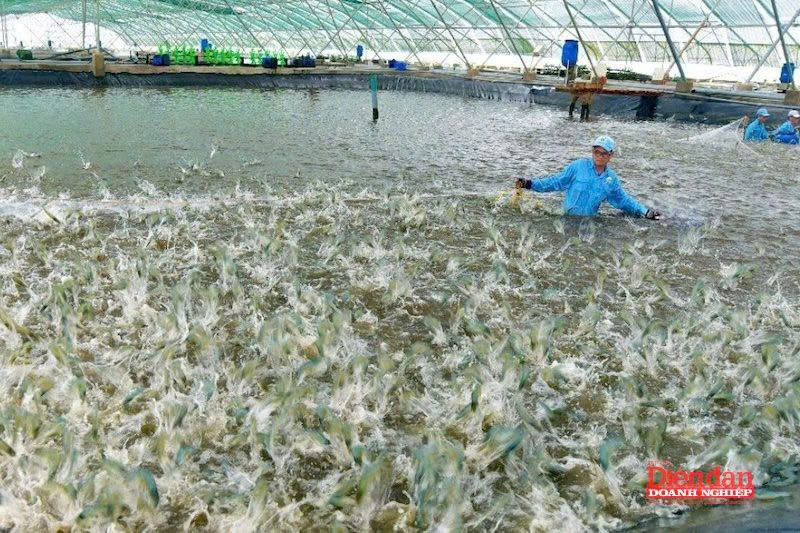
[In the shrimp industry, the first and most critical link in the entire value chain is the "seed stock," yet it is currently being left unattended.]
- Could you point out the shortcomings that are affecting the shrimp industry, specifically what are they?
In practice, postlarvae production is a highly specialized biological sector where each seed is simultaneously affected by multiple conditions, such as: water source; broodstock quality; environment; temperature; salinity; microbiome; diseases; production processes; biosecurity; management capacity... Therefore, if just one link falls out of control, the entire system can be impacted. That is also why many countries around the world do not strongly develop their postlarvae production industry. And this presents an opportunity for Vietnam to focus on heavily developing the shrimp seed industry, helping farmers minimize risks, moving toward high-value exports of both commercial shrimp and postlarvae, and becoming a key economic sector in the journey of green economic development.
However, for the green economic development roadmap to become a reality, state management agencies, citizens, and businesses must pay special attention, as this is an industry of science, technology, and large scale that demands high discipline and is not a game of luck.
A thought-provoking reality is that many enterprises have invested tens or hundreds of billions of VND to build modern production systems, such as broodstock farming areas, water treatment systems, testing laboratories, biosecurity systems, technology, human resources, and research...
Meanwhile, small-scale facilities or those that have not fully invested in high-standard infrastructure still participate in the market. This creates stark competition regarding costs and quality. If product quality is not clearly distinguished by the market and regulatory authorities, well-invested enterprises will face significant disadvantages, farmers will face risks, and the danger of bankruptcy is entirely possible. Consequently, the goal of sustainable development for Vietnam's shrimp industry will certainly fail to meet expectations.
- Based on what you said, is seed stock the vital factor for the shrimp industry?
Exactly, a good foundation makes a sturdy house. In general business operations and the shrimp industry in particular, the most important factor is not price but quality, reputation, and trust. Prices may rise today and fall tomorrow, but reputation and trust are eternal. This is the vital link for the shrimp industry to develop sustainably.
Therefore, in the shrimp industry, what is more concerning is that if sub-standard or untraceable postlarvae batches appear on the market, the risk will not stop at damage to a single farming crop; it could trigger cascading consequences: damage to farmers, increased risk of disease outbreaks, negative impacts on neighboring farming areas, reduced market trust, and harm to the reputation of the entire industry.
Ultimately, the ones who suffer the most are farmers and legitimate businesses. A modern economy cannot develop if competition relies primarily on low prices; it must compete based on quality, credibility, and national objectives.
Therefore, for the shrimp industry to go further in the global integration journey, businesses need to be encouraged to compete fairly through clear standards, such as quality, technology, productivity, traceability, brand reputation, and technical services. That is the true foundation for the long-term development of the shrimp industry.
- To ensure sustainable development for the shrimp industry and aim for high-value exports, what is the most important task at this time, sir?
If we truly consider the shrimp industry a national strategic economic sector, seed stock must be managed as a strategic asset. A reform in postlarvae management is needed, shifting from procedural management to quality- and data-driven management.
Concurrently, we need centralized planning for standardized seed production zones while raising biosecurity requirements for production facilities and enhancing electronic traceability for each seed batch.
In addition, we should develop independent testing systems, encourage enterprises to invest in research and breeding, improve disease surveillance capabilities, increase market transparency, and strictly handle violations according to the law. This is not only the responsibility of regulatory agencies but also of enterprises, associations, scientists, and farmers alike.
If we are determined to build a transparent production system based on science, standards, and responsibility, Vietnam's shrimp industry will not only maintain its position in export turnover but also have the opportunity to become a model of sustainable development for the global seafood industry, contributing to realizing Vietnam's green economic development goals on the path to global integration.
Thank you very much, sir!