VIETNAM CHAMBER OF COMMERCE AND INDUSTRY
Liên Đoàn Thương Mại Và Công Nghiệp Việt Nam
Mon, Apr 03, 2023, 15:43:00
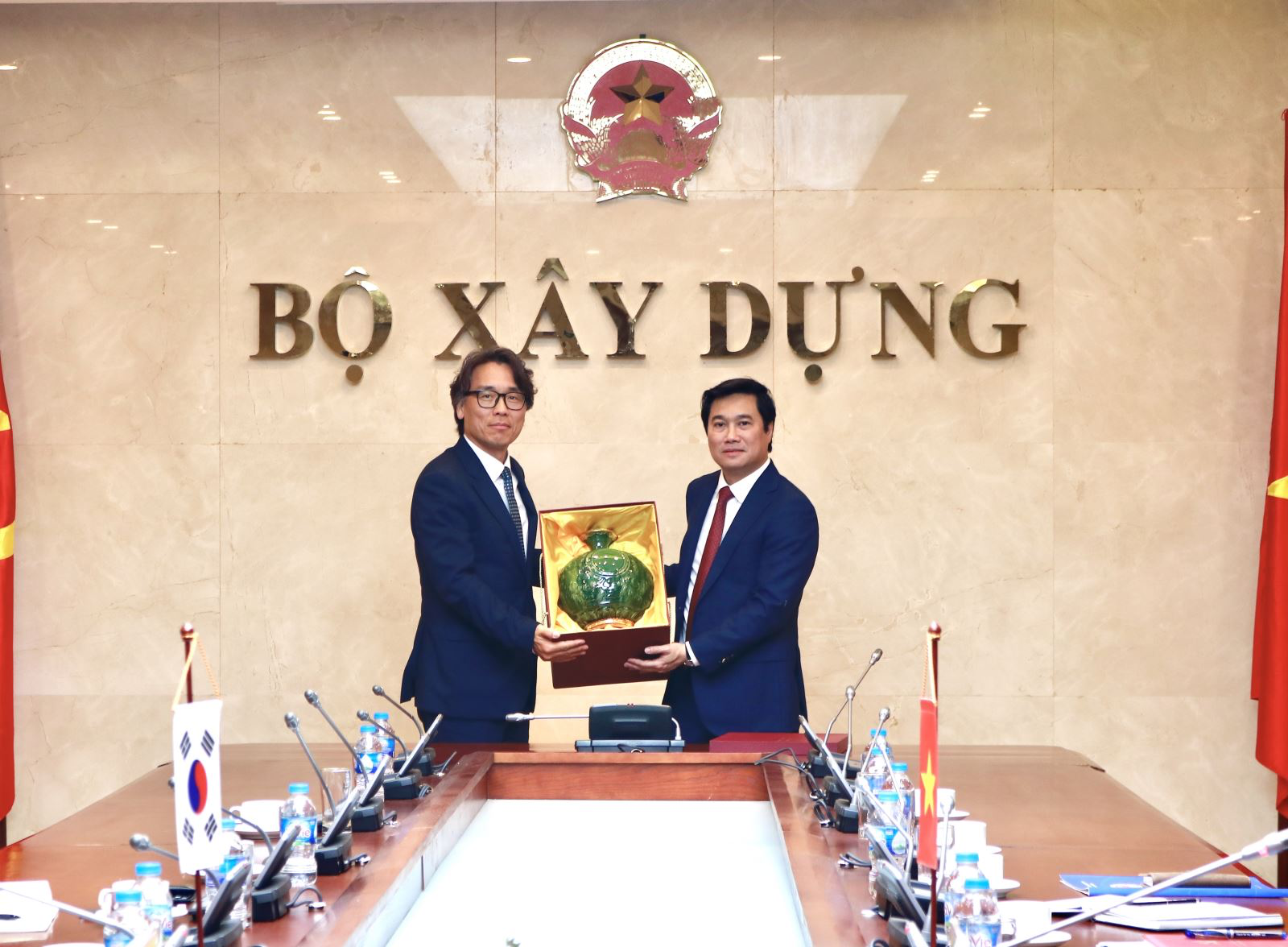
The notion of conducting an official development assistance (ODA) project on the construction of an industrial cluster concentrating on waste treatment in Vietnam, from which to undertake information exchange and technology transfer between the two countries, was offered on March 31 by Kum Han Seung, the South Korean Minister of Environment.
| Deputy Minister Nguyen Tuong Van and Deputy Minister Kum Han Seung. Photo: Ministry of Construction |
Similar to Vietnam, South Korea had a period of fast economic expansion and addressed environmental issues by modifying its policies. Deputy Minister Seung said that based on this experience, South Korea is ready to help Vietnam secure the attainment of shared global objectives.
Early in December, Vietnam and South Korea created a comprehensive strategic alliance. At the 19th meeting of the Intergovernmental Committee for Economic-Commercial and Scientific-Technological Cooperation in October, the Ministry of Planning and Investment (MPI) stated that ODA and subsidies will be prioritised for healthcare, climate change, poverty alleviation, education and training, and large-scale infrastructure projects.
Vietnam is Korea's top-priority partner for development assistance, receiving around 20 per cent of Korea's overall funding in this area. According to the MPI, South Korea's yearly aid to Vietnam exceeds $500 million, of which 90 per cent is official development assistance and 10 per cent is grant aid.
According to MPI data, South Korea has pledged to offer Vietnam roughly $3.75 billion in ODA loans since the end of 2020, and there are presently 22 active projects employing this financing, totalling around $1.3 billion.
As pledged by the Vietnamese prime minister at COP26, Vietnam is advancing towards green and clean technology to realise the goals of green growth and zero emissions by 2050.
According to research from the Ministry of Natural Resources and Environment, rubbish generated within homes in metropolitan areas grew by 10-16 per cent between 2016 and 2020. It totals around 35,600 metric tonnes per day, which accounts for about 55 per cent of the total across the nation.
According to this data, 71 per cent of the volume is handled by burial, 16 per cent is treated at composting facilities, and 13 per cent is burned.