VIETNAM CHAMBER OF COMMERCE AND INDUSTRY
Liên Đoàn Thương Mại Và Công Nghiệp Việt Nam
Mon, Aug 22, 2022, 13:48:00
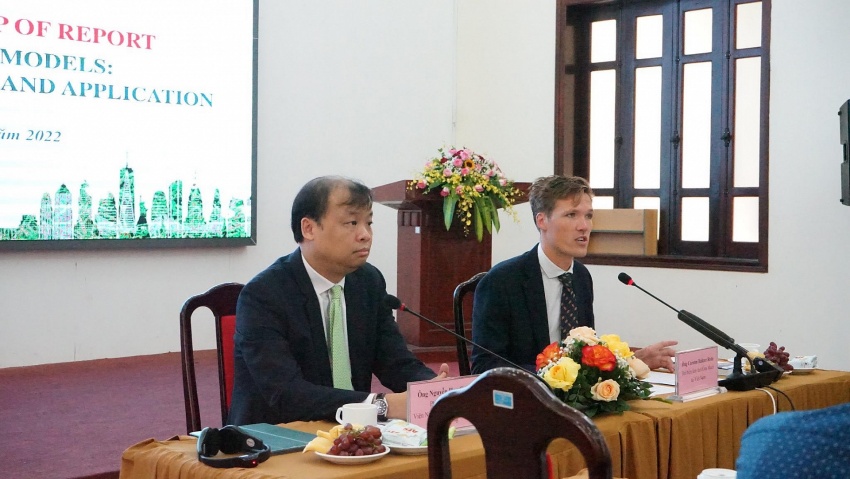
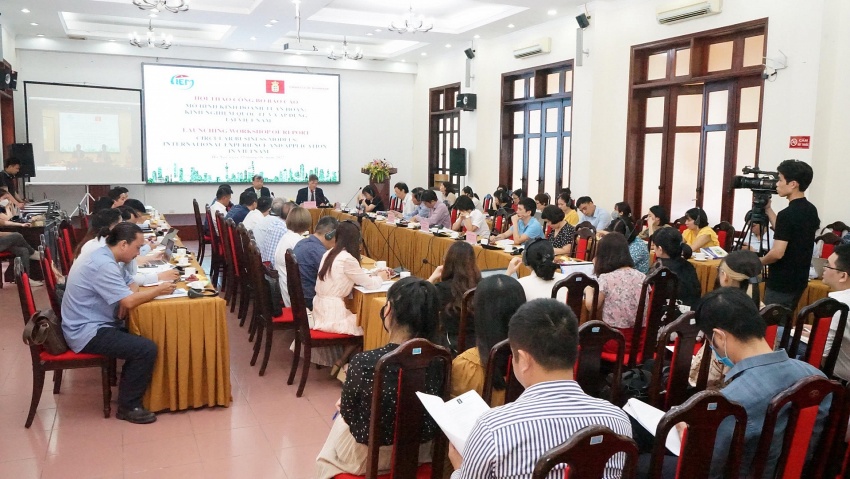
| The workshop under the co-chair of CIEM deputy director Nguyen Hoa Cuong and Carsten Baltzer Rode, deputy head of Mission at the Embassy of Denmark |
The seminar aimed to share research results on the current situation and solutions to develop circular business models in Vietnam. It focused on the necessity of circular business and international experience on the subject, as well as the current situation for Vietnamese enterprises and recommendations on relevant mechanisms and policies.
In Vietnam, the ten-year socioeconomic development strategy for 2021-2030 has set out the orientation to build a green, circular, and environmentally friendly economy, and to promote the circular economy for production. Since then, the Prime Minister issued Decision No.687/QD-TTg dated June 7, approving the project of circular economy development in Vietnam.
At the seminar, Nguyen Hoa Cuong, CIEM deputy director said that there are many companies transforming their business models on the basis of regulations and policies on sustainable development such as the national strategy on green growth, the national action programme on sustainable production and consumption, and the strategy on cleaner industrial production.
| Circular business is becoming a trend around the world and is considered one of the most critical solutions to realise sustainable development goals, effectively respond to climate change, and mitigate the negative impacts on the environment. |
Numerous businesses have realised their social responsibility and built circular business models to ensure their sustainable development, contributing to the overall sustainable development of the economy. These include Vinamilk, Nestle, Coca-Cola, Lagom Vietnam, and Duc Giang Chemical, among others.
In the field of recycling, many circular business models have been operating and reporting positive outcomes, however, they are not systematic.
Deputy head of the Research and Development Department at CIEM Trinh Duc Chieu said, "Based on the experience of Europe, Denmark, and other countries, circular business is becoming a trend around the world and is considered one of the most crucial solutions to realise sustainable development goals, effectively respond to climate change, and mitigate the negative impacts on the environment."
A survey by CIEM across 508 enterprises nationwide reported that nearly 80 per cent of responses followed the normal perception and 60-70 per cent of them saw that the circular economy plays an important role. However, their knowledge about circular business is limited, with only 20-30 per cent clear and 3-6 per cent very clear.
| Solutions for developing circular business |
The role of the state is very important, including in the building of a legal framework and policies to support and create favourable conditions for enterprises to overcome challenges when converting their business models from linear to circular.
CIEM said that the obstacles to the development of circular business models are resources, technology, and markets, as well as the fact that awareness of the circular economy and circular business in Vietnam is not uniform.
In addition, the legal framework is not complete, clear, and synchronous. The capacity and resources of many enterprises do not meet the requirements. Business culture, consumption habits, and legal policies are still mainly based on the traditional linear business philosophy.
Therefore, in order to achieve the sustainable development goals and Vietnam's commitments at COP26, CIEM recommended developing a circular economy in general and circular business in particular. Important solutions need to focus on increasing awareness of the circular economy and business and perfecting the relevant legal and institutional frameworks.
Along with that, CIEM believes that the government needs to promote the integration of circular economy development and circular business solutions in the socioeconomic development plan while promulgating specific policies and developing criteria and standards to measure the level of circular businesses and providing detailed instructions on the application of the circular business by industry.
In order to take advantage of opportunities and limit the difficulties when aiming for sustainable development, businesses need to proactively develop long-term strategies for sustainable development.
|
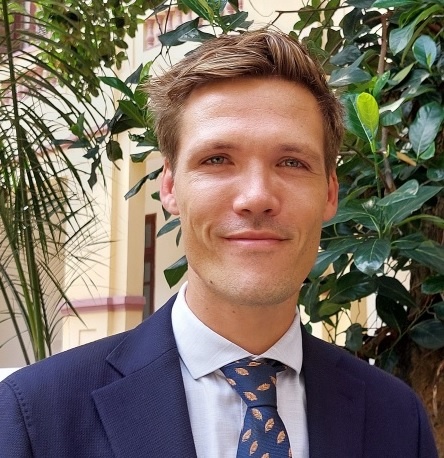
Carsten Baltzer Rode, deputy head of Mission at the Embassy of Denmark Green transition is inevitably tied to a circular economy. Denmark has been committed to green transition and a green economy for a long time as we started early and are now a global front around that. It's important to note that the transition to a circular economy is something that requires a holistic approach, meaning a whole nation and a whole government approach. It cannot just be a job for the central authorities. It has to also involve businesses, civil society, and academic institutions. They all need to be committed for the circular economy models to actually work. Circular economic development in Denmark is very business driven. Without the industries, it will not be successful. So, a key is to encourage and enable companies to commit to developing circularity as a core part of their business.
|