VIETNAM CHAMBER OF COMMERCE AND INDUSTRY
Liên Đoàn Thương Mại Và Công Nghiệp Việt Nam
Mon, Sep 09, 2024, 02:38:00
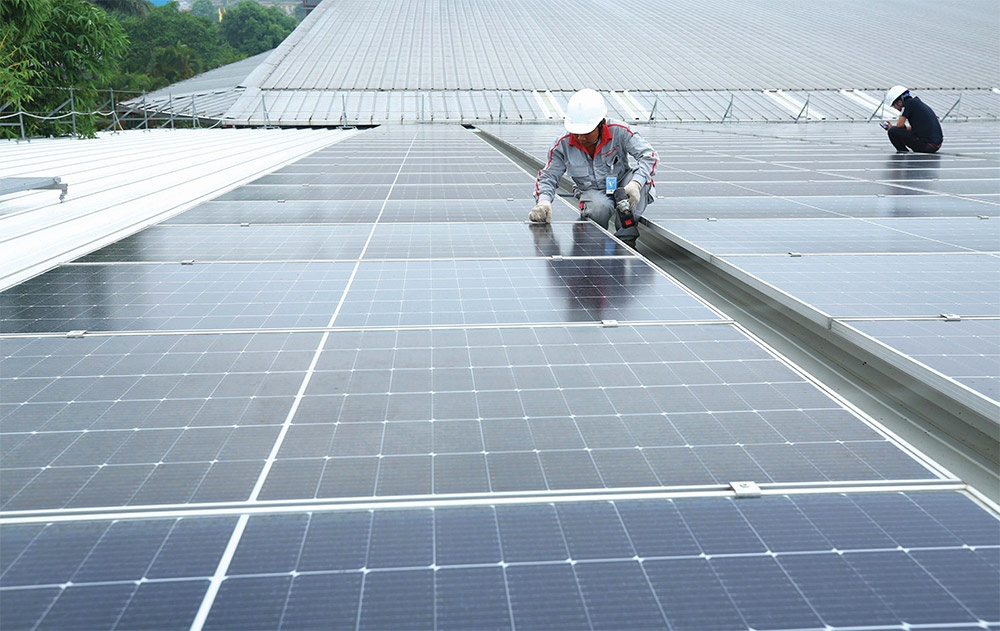
| More specific regulations are still sought after to ensure solar potential is attained, Photo: Le Toan |
At a forum on rooftop solar power for businesses more than a week ago in Ho Chi Minh City, most experts and companies shared the opinion that rooftop solar power helps them proactively provide electricity for manufacturing and operation.
Vo Tan Thanh, vice president of the Vietnam Chamber of Commerce and Industry (VCCI) said that the nation’s Power Development Plan VIII proposed solutions in developing renewable energy sources, setting a goal that half of all office buildings and homes will install and use self-produced and self-consumed rooftop solar power by 2030.
“This resource will develop with unlimited capacity due to not connecting to the national grid,” Thanh said. “This is a source of distributed solar power on-site, with many advantages over other renewable energy sources because there is no loss during transmission and distribution over long distances. It matches the needs of on-site loads.”
This will be an additional source of clean electricity to reduce pressure on the transmission system and ensure a proactive power source for production and business enterprises, he stated.
To meet the needs of the economy and ensure energy security, the Ministry of Industry and Trade has provided the latest updates to propose and complete the draft decree and regulations on encouraging the development of self-produced and self-consumed rooftop solar power to submit to the government.
“This preferential policy for the development and installation of rooftop solar power systems is the desire of all sectors, industries and businesses. Using clean energy not only saves production and business costs, reduces carbon emissions, but also maintains stable production during times of high load in the hot season,” said the VCCI’s Thanh.
Tran Thien Long, permanent vice president of the Vietnam Industrial Real Estate Association, said rooftop solar power for businesses is necessary for investors in industrial zones (IZs), export processing zones, and other secondary investors.
“The potential for rooftop solar power in these zones is huge. In Ho Chi Minh City alone, there are nearly 2,000 investors. If they all deploy, about 2,000MW will be generated,” Long said. “Currently, we have 428 IZs and more than 1,000 industrial clusters, of which, there are nearly 80,000 secondary investors. This is an essential number to develop rooftop solar power.”
There are a large number of secondary investors and exporters in IZs trying to convert to green and renewable energy. It will be a huge problem for them without green certificates, Long added. However, businesses still face many difficulties in implementation, especially in terms of legal regulations.
“All firms and secondary investors hope that the legality of rooftop solar power must be obvious, specific, and must be implemented synchronously,” Long stressed.
VCCI vice president Thanh said it is still difficult for businesses to invest and install rooftop solar power systems because of no specific regulations. “Procedures and guidance documents from ministries and agencies are not clear and consistent,” he claimed.
From a business view, Dang Khai Hoang from Solarvest Vietnam Company said that the first “shock” the company faced was the overwhelming number of administrative procedures, and it was difficult to know which procedures were necessary.
“For us, it is very difficult to deploy other types of energy that can meet the greening demand for exporting abroad,” Hoang said.
Nguyen Xuan Thang, general director of Schaeffler Vietnam, said that businesses are struggling with connecting to IZ power grids. Schaeffler has already deployed rooftop solar power systems in the form of self-production, self-consumption, and self-investment with a capacity of about 2.7MW. However, the industrial developer Amata does not allow Schaeffler to connect to the power grid of the industrial area.
“Although the policies, decrees, and circulars seem reasonable, putting them into effect will raise many shortcomings at the local level, and at the management level of the IZs. Therefore, we hope that if the decree on self-produced and self-consumed rooftop solar power is issued, it will clearly state how to overcome these situations,” Thang said.