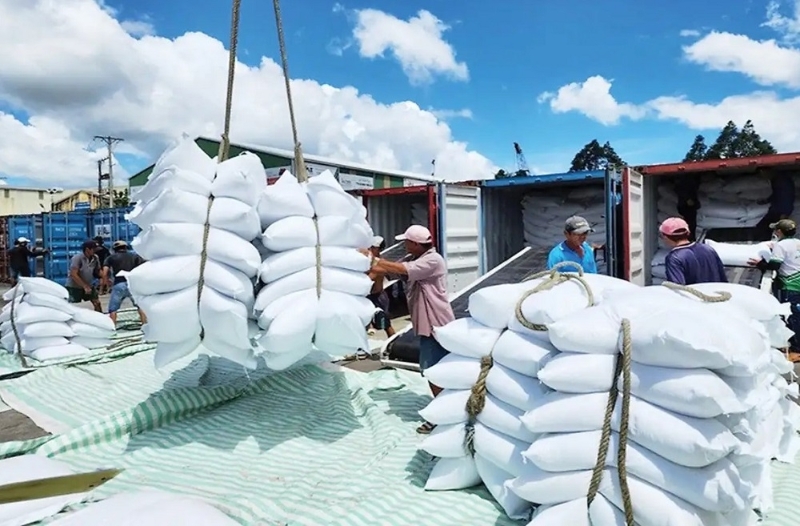
Vietnam's rice exports to Senegal saw a massive surge in 2025, reaching 168,020 tons with a turnover of $52.57 million—a nearly 30-fold increase compared to 2024.
According to Vietnam Customs, high-quality Vietnamese 100% broken fragrant rice is now a common sight in Senegalese supermarkets, retailing in 5kg and 25kg bags at approximately $1.3 per kg.
In July 2025, during an official visit to Senegal by National Assembly Chairman Tran Thanh Man, the ministries of Industry and Trade of both nations signed a Memorandum of Understanding (MOU) on rice trade. Under this agreement, Vietnam aims to export approximately 100,000 tons of rice annually to Senegal.
This agreement is designed to bolster food security for Senegal while expanding Africa's market reach and diversifying export outlets for Vietnamese rice. Both parties are currently and actively implementing the MOU to further increase export turnover to this market.
According to the Vietnam Trade Office in Algeria (which also covers Senegal), Senegal is a major rice importer, purchasing an average of 1 million tons per year, primarily low-cost 100% broken rice. The country has one of the highest per capita rice consumption rates in West Africa, at approximately 117 kg per person annually.
The United States Department of Agriculture (USDA) estimates that Senegal’s rice consumption will reach approximately 2.26 million tons in the 2025/2026 crop year, a 2% increase driven by population growth. By 2026, Senegal's rice imports are projected to hit 1.5 million tons, accounting for 70% of total market demand. Key suppliers include India, Thailand, China, Pakistan, Uruguay, and Vietnam.
Beyond serving its domestic population of over 19.3 million, Senegal acts as a regional hub, re-exporting rice to neighboring countries such as Mauritania, Guinea-Bissau, and Gambia.
Experts highlight that Vietnamese rice holds a competitive advantage in Senegal. The market has been fully liberalized since 1995, when the Senegalese government abolished the state monopoly on rice imports. Furthermore, while the Senegalese government has implemented policies to promote local wet-rice cultivation to achieve self-sufficiency, domestic production currently meets only 25% to 30% of the nation's demand.