VIETNAM CHAMBER OF COMMERCE AND INDUSTRY
Liên Đoàn Thương Mại Và Công Nghiệp Việt Nam
Mon, Mar 09, 2026, 14:48:00
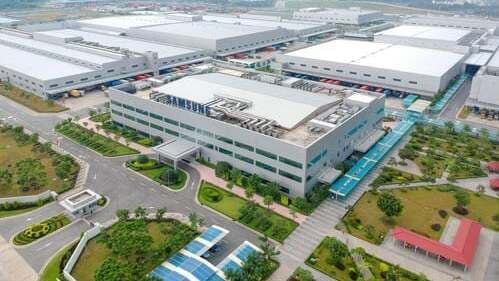
The four units - Samsung Electronics Vietnam Thai Nguyen (SEVT), Samsung Electronics Vietnam (SEV), Samsung Display Vietnam (SDV) and Samsung Electronics HCMC CE Complex (SEHC) - form a key part of Samsung’s global manufacturing network, producing more than half of the company’s worldwide smartphone output alongside other electronics products.
Last year, they booked total revenue of $62.12 billion, up 8.1% year-on-year.

Their combined revenue is equivalent to roughly 13% of Vietnam’s total export value of $475 billion in 2025, highlighting the continued strength of Samsung’s operations in the country despite global trade pressures, including reciprocal tariffs introduced by President Donald Trump on certain imported goods.
Among the subsidiaries, Samsung Electronics Vietnam Thai Nguyen (SEVT), based in the northern province of Thai Nguyen, generated the highest revenue at $25.97 billion, up 12% from the previous year.
Samsung Electronics Vietnam (SEV), located in the northern province of Bac Ninh, followed with $16.71 billion, rising 11.6%, while Samsung Display Vietnam (SDV), also in Thai Nguyen, reported $14.09 billion, slightly down 1.8% year-on-year.
Samsung Electronics HCMC CE Complex (SEHC), located in southern Ho Chi Minh City, posted revenue of $5.35 billion, up 8.7%.
In terms of profitability, both SEVT and SEV generated more than $1 billion in net profit, with $1.68 billion and $1.09 billion, respectively. SDV recorded profits of $618 million, while SEHC posted $293 million.
Globally, Samsung Electronics reported $234.6 billion in revenue and $31.8 billion in net profit in 2025. Based on these figures, Samsung’s Vietnam operations accounted for approximately 26.5% of the group’s global revenue and 11.6% of its total profits, underlining the country’s importance as a major manufacturing hub for the giant.
The financial statements also showed that Samsung set aside $302.1 million in additional tax payments in Vietnam under the Global Minimum Tax framework, which requires multinational corporations to pay a top-up tax to meet the 15% global minimum rate if their effective tax rate in a jurisdiction falls below that threshold.
Samsung has invested about $23.2 billion in Vietnam, making it the country’s largest foreign investor. Beyond the four subsidiaries, the group also operates other major facilities such as Samsung SDI Vietnam, Samsung Electro-Mechanics Vietnam and a major research and development center in Hanoi, with most of its manufacturing ecosystem concentrated in northern Vietnam.