VIETNAM CHAMBER OF COMMERCE AND INDUSTRY
Liên Đoàn Thương Mại Và Công Nghiệp Việt Nam
Tue, Jul 14, 2026, 14:38:00
According to the company's latest securities filing, TLB will use proceeds from a recent share offering to finance the construction of the new facility and install production lines at its wholly owned Vietnamese subsidiary, TLB Vina.
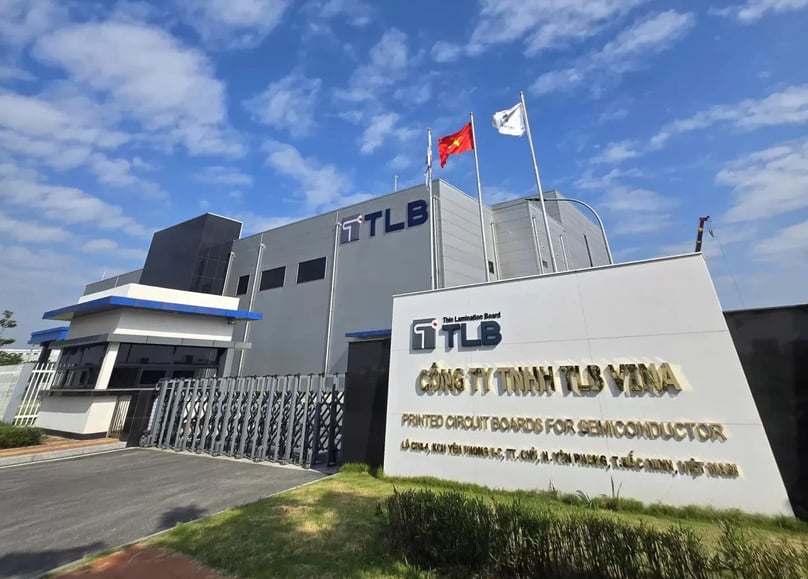
TLB Vina was established in November 2021, with its first factory in Vietnam commencing operations in October 2024.
At a recent meeting with Bac Ninh authorities, the company said its existing project represented a total investment of $61.1 million on a 3.5-hectare site at the Yen Phong II-C Industrial Park.
During the first quarter of 2026, TLB Vina generated revenue of $8.05 million, contributed VND16.7 billion ($636,000) to the state budget and employed about 250 workers. Its major customers include Samsung, Hana Micron, Hanyang Digitech and Valueplus.
Share sale raises over 133 billion won
TLB raised 133.1 billion won (over $89 million) through the issuance of 2.073 million common shares via a rights offering to existing shareholders, followed by a public offering of unsubscribed shares. The final subscription price was set at 64,200 ($43) won per share.
The company classified the entire amount raised as capital expenditure.
As of July 8, existing shareholders had subscribed to 95.21% of the shares offered. The remaining 99,201 shares were made available through a public subscription on July 9-10.
According to the prospectus, the second Vietnam plant is expected to cost about 200 billion won. Of that amount, approximately 133.09 billion won will come from the equity offering, while the remaining 66.91 billion won will be financed through existing cash reserves and additional borrowings.
Around 28.73 billion won ($19.24 million) will be allocated to land preparation, factory design and construction, cleanroom installation, power and water systems, wastewater treatment facilities and other infrastructure.
Most of the remaining investment will be used to purchase production equipment, including CNC and laser drilling machines, copper plating systems, circuit patterning equipment, surface treatment lines, solder mask printing, lamination systems, and factory automation equipment. Installation is scheduled between the fourth quarter of 2026 and the second quarter of 2027.
Capacity to double
The second plant will be built adjacent to TLB Vina's existing facility in Bac Ninh and will have an effective production capacity of around 20,000 square meters of PCBs per month, matching the scale of the company's main manufacturing facility in Ansan, South Korea.
TLB currently operates factories in Ansan and Vietnam with a combined nameplate capacity of about 348,000 sqm annually, or roughly 29,000 sqm per month.
However, the company said the increasing share of products using Build-Up Via Hole (BVH) technology has lengthened processing times and created bottlenecks in several production stages, reducing effective monthly output at existing facilities to around 20,000 sqm.
Once the second Bac Ninh plant becomes operational, TLB expects to increase its effective production capacity to approximately 40,000 sqm per month, doubling current output. Construction is scheduled to begin in the second half of 2026, with the new capacity expected to make a meaningful contribution to revenue from the first quarter of 2028.
Unlike the company's first Vietnam facility, which primarily handles selected manufacturing processes transferred from South Korea, the new plant will carry out nearly the entire PCB production process, including material preparation, lamination, drilling, plating, circuit formation, finishing, inspection and packaging.
TLB specializes in PCBs for memory modules and solid-state drives, supplying major memory manufacturers including Samsung Electronics, SK Hynix and Micron.
In its offering documents, the company said continued expansion of AI servers and data centres is expected to drive demand for high-performance memory module PCBs.
TLB also forecasts stronger demand for PCBs used in SoCAMM2 memory modules as Nvidia rolls out its Vera Rubin platform, while demand is expected to grow for PCBs used in DDR5 RDIMM server memory, DDR6 products and memory solutions based on Compute Express Link (CXL) technology.
The company said the scale and timing of the investment could be adjusted depending on business conditions, construction progress and actual implementation costs.