VIETNAM CHAMBER OF COMMERCE AND INDUSTRY
Liên Đoàn Thương Mại Và Công Nghiệp Việt Nam
Sat, Nov 16, 2024, 05:08:00
Under Decision No. 2521/QD-BTC, issued by the Ministry of Finance, the General Department of Vietnam Customs is tasked with monitoring the program's progress and reporting any issues beyond its authority to the ministry.
To bring the initiative to life, the General Department has assigned Director of Customs Control and Supervision Department, Director of Lang Son Customs Department and leaders of affiliated customs units to collaborate with Nanning Customs and the General Department of China Customs. This cooperation aims to develop an actionable plan to launch the smart border model between Lang Son (Vietnam) and Guangxi (China) provinces, focusing on customs collaboration under Decision No.492/QĐ-TCHQ dated March 8th, 2024 of General Department of Vietnam Customs.
The plan includes drafting amendments to Decree 85/2019/ND-CP on import-export procedures, transit goods, and vehicles, in alignment with both the National Single Window and ASEAN Single Window mechanisms, as well as the specialized inspection of goods to support streamlined data exchange between Vietnamese and Chinese customs.
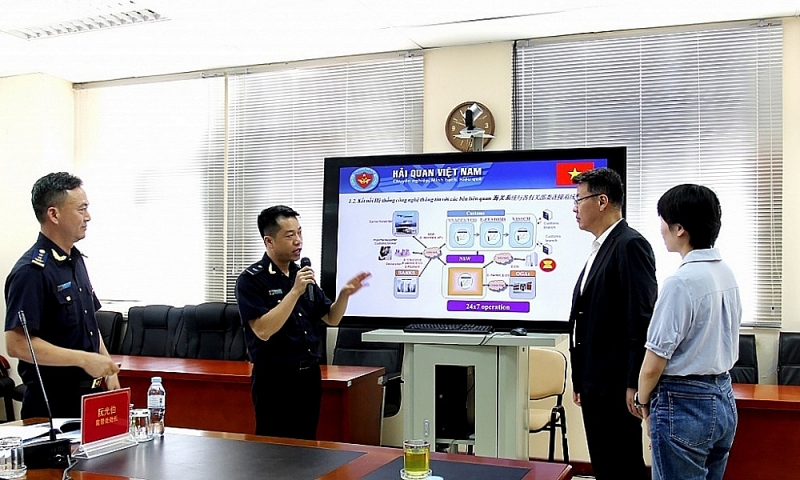 |
| Lang Son Customs exchanged experiences with Nanning Customs (China) on building a smart border gate model. Photo: Tô Hà |
Upgrades to the National Single Window Portal are planned to accommodate these amendments, enabling automated receipt of export shipment data from Nanning Customs and subsequent sharing with Vietnamese border agencies. Similarly, Vietnamese export data will be transmitted back to Nanning Customs and relevant Vietnamese agencies.
Vietnam Customs has also established a task force working with Nanning Customs to implement the smart border pilot program. This partnership includes drafting a Memorandum of Understanding (MoU) to standardize procedures for goods classification, customs declarations, and transport coordination between the two regions.
The General Department of Vietnam Customs is drafting a temporary set of guidelines covering customs procedures and monitoring processes for goods transiting through the smart border gate. These guidelines will specify the roles and responsibilities of each involved agency, ensuring smooth coordination among all stakeholders.
A workshop will be held to gather feedback on the draft guidelines from Lang Son Customs, other specialized units, local government agencies, and warehousing businesses in Lang Son Province.
To support the initiative’s digital infrastructure, the General Department of Vietnam Customs will collaborate with the Ministry of Information and Communications, Lang Son Province People’s Committee, and relevant agencies to assess and secure the network for the smart border gate system. Coordination with Chinese customs will ensure data connectivity, cybersecurity, and safe information exchange across borders, contributing to national security.
The plan also includes procuring essential equipment for customs monitoring at the smart border gate. Lang Son Customs, in conjunction with related agencies, will conduct on-site assessments to identify the specific equipment needs for customs inspection and oversight, reporting back to the General Department to establish a phased procurement schedule.
Finally, Lang Son Customs will guide warehousing and logistics firms in upgrading their infrastructure, installing equipment, and setting up customs inspection areas within the smart border gate. These upgrades will facilitate the movement of goods through the border and comply with regulations stipulated in Decree 68/2016/ND-CP, as amended by Decree 67/2016/ND-CP.