VIETNAM CHAMBER OF COMMERCE AND INDUSTRY
Liên Đoàn Thương Mại Và Công Nghiệp Việt Nam
Mon, Jan 19, 2026, 14:04:00
On January 16, in Hanoi, the Military Industry - Telecoms Group (Viettel) commenced the construction of the first semiconductor chip manufacturing plant in Vietnam. The project is being implemented by Viettel under tasks assigned by the Ministry of National Defense based on a resolution of the Government. This represents a significant milestone as Vietnam establishes domestic semiconductor manufacturing capacity for the first time, laying the foundation for mastering core technologies and developing a local semiconductor ecosystem.
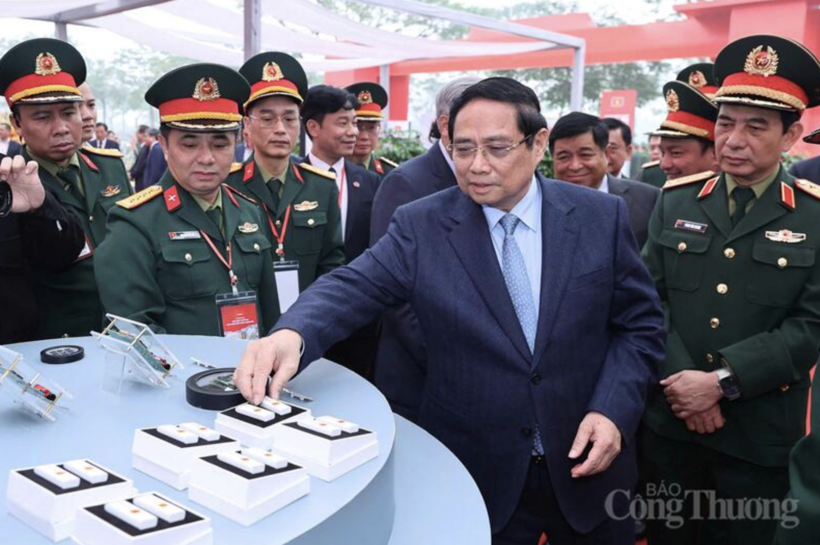
Prime Minister Pham Minh Chinh highly evaluates chips researched and manufactured by Viettel. Photo: Nguyen Nam
The groundbreaking ceremony was attended by Party General Secretary To Lam, Prime Minister Pham Minh Chinh, and Minister of National Defense General Phan Van Giang. Also in attendance were leaders from the Office of the President, the Office of the Government, the National Assembly, various central ministries, sectors, and localities, as well as representatives from domestic and international organizations, enterprises, and partners.
Viettel sets 2027 milestone for semiconductor plant trial production
The semiconductor chip manufacturing plant project has officially commenced construction at the Hoa Lac Hi - Tech Park in Hanoi. Spanning 27 hectares, the facility is identified as a key national infrastructure for research, design, testing, and production of chips, meeting the demand for strategic sectors such as aerospace, telecommunications, IoT, and medical equipment.
A complete chip product undergoes six stages from product definition to integration. Although Vietnam has participated in five stages, chip fabrication - the most complex phase - remains a gap. The construction of this plant will help close the entire production cycle within the country. Chip fabrication is a sophisticated process consisting of 1,000 technological steps over three months on pure silicon wafers, requiring the highest level of discipline and technology management capacity.

Lieutenant General Tao Duc Thang, Chairman and General Director of Viettel Group. Photo: Nguyen Nam
Viettel Chairman and General Director Lieutenant General Tao Duc Thang stated that the unit has been researching this field since 2017. After more than six years, Viettel has successfully designed civil 5G chips and specialized chips for military equipment. Having to outsource manufacturing abroad in recent years has helped the Group accumulate valuable experience in production chains and ecosystems, preparing it for strategic missions. To prepare for the project, Viettel has proactively cooperated with major semiconductor associations and corporations from the US, Taiwan (China), Japan, and Europe to acquire technology and efficient operational models.
Regarding human resources, Viettel currently possesses a high - quality engineering team with over 70 percent holding master’s degrees, along with many experts from leading global semiconductor companies. The Group aims to complete construction, receive technology transfer, and begin trial production by the end of 2027. During the 2028 to 2030 period, the plant will optimize processes and improve efficiency as a basis for researching more modern technological processes.
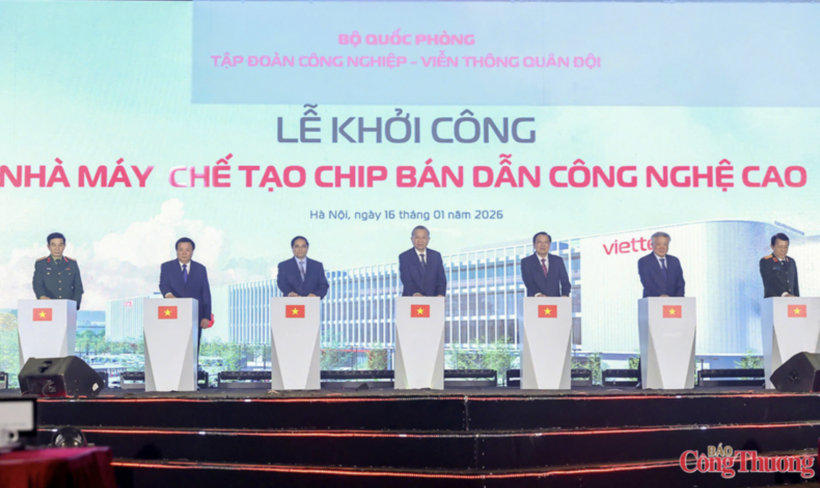
General Secretary To Lam and Party and State leaders perform the groundbreaking ceremony. Photo: Nguyen Nam
Lieutenant General Tao Duc Thang affirmed that Viettel will expand its cooperation ecosystem with major corporations such as FPT and Vingroup, alongside leading research institutes and universities. With a pioneering spirit, Viettel commits to taking progress as discipline and quality as the standard to successfully implement Vietnam’s semiconductor industry development strategy.
Building a national semiconductor ecosystem from the first chip plant
Addressing the groundbreaking ceremony of Vietnam’s first high - tech semiconductor chip manufacturing plant, Prime Minister Pham Minh Chinh emphasized that this is an event of particular significance, aiming to realize the national semiconductor industry development strategy and bring Vietnam deeper into global value chains.
The Prime Minister pointed out five key meanings of the project. First, it gradually masters core technologies and forms domestic chip manufacturing capacity to reduce external dependence. Second, it ensures technological security and links economic development with the dual - use industry. Third, it builds a national ecosystem connecting the “three pillars” consisting of the State, enterprises, and scientists. Fourth, it trains a team of experts to master technology. Fifth, it creates a leading nucleus to attract FDI capital and private enterprises to participate in the supply chain.
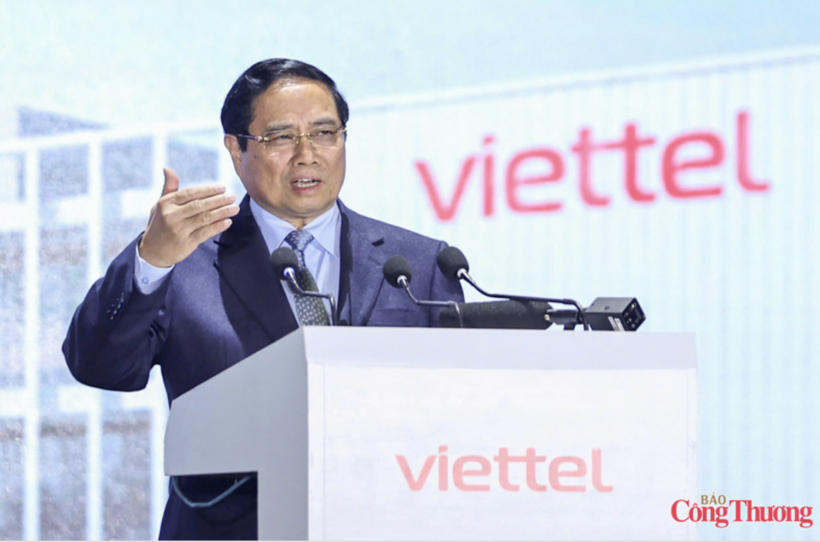
Prime Minister Pham Minh Chinh delivers a keynote speech. Photo: Nguyen Nam
The Prime Minister highly appreciated the pioneering role of the Ministry of National Defense and Viettel Group in successfully designing and producing 5G chips. The Government confidently assigned Viettel to directly implement this first manufacturing plant with the spirit of “completing any task and overcoming any difficulty”.
To develop this specific and challenging industry, the Prime Minister requested the drastic implementation of the Semiconductor Industry Development Strategy to 2030, with a vision to 2050. The goals by 2030 are for Vietnam to have at least 100 chip design enterprises, one manufacturing plant, 10 packaging and testing plants, and to train over 50,000 high - quality engineers.
Economically, the Prime Minister set a target for semiconductor industry revenue to reach over USD 25 billion per year, with value - added in Vietnam reaching 10 to 15 percent, while bringing electronics industry revenue past the USD 225 billion mark.
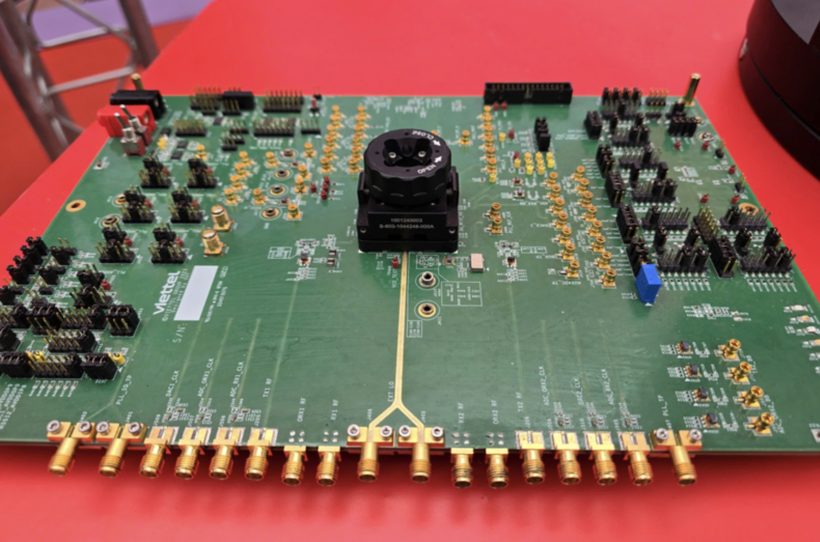
Viettel showcases its semiconductor chip products at the event. Photo: Thu Huong
For Viettel, the Prime Minister suggested that the group complete the project on schedule and perform three central tasks: Mastering chip manufacturing technology, supporting the startup and research ecosystem in chip design, and becoming a practical semiconductor production human resource training center.
The project, implemented in the 2026 to 2030 period at Hoa Lac, is not only a foundation for accessing advanced technology but also a milestone affirming Vietnam’s determination for “Technological Autonomy, Sustainable Future.”