VIETNAM CHAMBER OF COMMERCE AND INDUSTRY
Liên Đoàn Thương Mại Và Công Nghiệp Việt Nam
Fri, Jun 05, 2026, 11:11:00
The International Energy Agency (IEA) has warned that global oil inventories could fall to “dangerous levels” before the peak summer demand season, as the prolonged conflict in the Middle East continues to cause serious disruptions to global energy supply.
.jpg)
The conflict in the Middle East has now entered its fourth month and is disrupting global energy markets. Illustrative photo.
Global oil reserves risk sharp decline
Speaking at the S&P Global Energy Middle East Oil and Gas Conference in London on Tuesday, Toril Bosoni, head of the IEA’s oil industry and markets division, said global oil inventories were continuing to decline at an alarming pace.
“We are seeing inventories continue to fall throughout the summer, and it is likely, or very likely, that we will reach record lows right before peak summer demand,” Bosoni said.
According to Reuters, Bosoni also said that even if the parties reached an immediate peace agreement, restoring normal operations in the Strait of Hormuz could take six to eight months.
The conflict in the Middle East has now entered its fourth month and is disrupting global energy markets. It has disrupted crude oil production in the Middle East, while the Strait of Hormuz, one of the world’s most important energy shipping routes, has effectively been almost closed.
Supply shortages have forced many countries to step up the use of strategic oil reserves. Meanwhile, supply losses in the Persian Gulf remain severe. According to an IEA report, as of last month, oil production in Gulf countries affected by the Strait of Hormuz crisis had fallen by 14.4 million barrels per day compared with the period before the conflict broke out.
This has heightened concerns that the global oil market will continue to face supply pressure in the coming months, even if the conflict is resolved through diplomatic agreements.
In terms of prices, at 6:35 a.m. on 3 June, according to Trading Economics and Oilprice, global oil prices recorded a sharp increase. WTI crude traded at USD 95.58 per barrel, up USD 3.4, or nearly 3.7%, from the previous day.
Viet Nam strengthens energy self-reliance
Energy security is no longer an issue only for oil-producing countries. It has become a strategic matter for every economy. Many countries are placing energy self-reliance at the top of their agenda as a factor in ensuring economic stability and national security.
Viet Nam is no exception to this trend. Since 1 June 2026, E10 biofuel gasoline has officially been distributed and sold nationwide, replacing traditional gasoline. The implementation of the biofuel roadmap is considered a global trend and is also seen as suitable for Viet Nam’s practical conditions.
Speaking at a recent seminar, Bui Ngoc Bao, Chairman of the Viet Nam Petroleum Association, said Viet Nam currently meets around 70% of its petrol and oil demand through the Nghi Son and Dung Quat refineries. However, this level of self-sufficiency is still not truly stable because Nghi Son depends entirely on imported crude oil from the Gulf region, while only Dung Quat uses crude oil extracted by Viet Nam.
According to him, recent developments in the Middle East have clearly exposed the risks of relying on imported fossil fuels when supply is disrupted and oil prices rise sharply. Therefore, the goal of the energy transition is to increase autonomy and gradually reduce dependence on external energy sources and markets.
Bao emphasized that if E10 gasoline is widely used, Viet Nam could reduce around 10% of gasoline derived from fossil fuels. In the future, if biofuels for diesel continue to be developed with higher blending ratios, as applied by many countries in the region, dependence on fossil fuels could fall further.
“For every additional 10% of biofuel, we reduce dependence on fossil fuels by another 10%. This is a very meaningful figure for national energy security,” Bao said, adding that the transition would help ensure energy security while contributing to green growth and sustainable development goals.
According to Do Van Tuan, Chairman of the Viet Nam Biofuels Association, India is an example Viet Nam should study when developing its energy self-reliance strategy. Although it does not have abundant oil resources and launched its biofuel programme later than many countries, India has developed rapidly, moving from E10 to E20 and then deciding to raise the blend to E30 to reduce dependence on imported fuels.
He said India, with hot and humid climatic conditions similar to Viet Nam’s, has already tested technical concerns such as moisture absorption and phase separation when using biofuel gasoline, and these have not become major practical barriers.
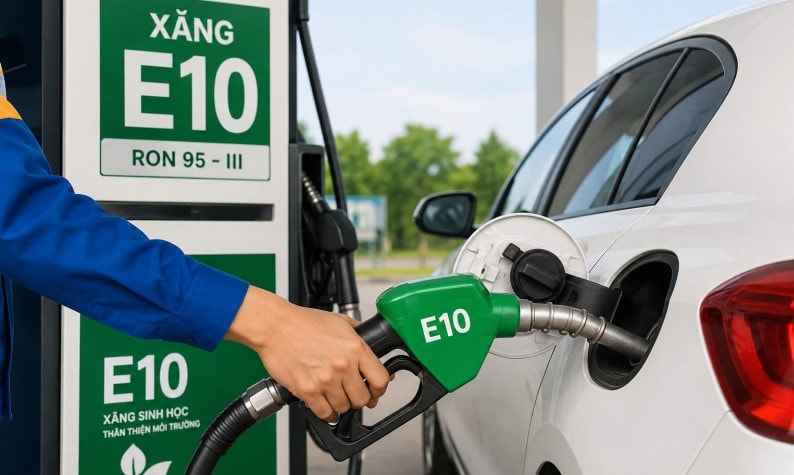
If E10 gasoline is widely used, Viet Nam could reduce gasoline derived from fossil fuels by around 10%. Illustrative photo.
“India shows that biofuel is not only a technical solution but also a strategic solution for energy self-reliance,” Tuan said. In the context of Viet Nam’s need to diversify energy sources, alongside developing electric vehicles and continuing to use fossil fuels during the transition period, biofuels could play an important role in reducing dependence on imported energy while limiting the environmental impact of fossil fuels.
In practice, as E10 gasoline is officially rolled out nationwide, one of the public’s biggest concerns is whether this fuel affects vehicle engines. According to regulatory agencies and many automobile and motorcycle manufacturers, most vehicles currently in circulation can use E10 gasoline normally if they are properly maintained.
However, users should still carry out regular maintenance of fuel systems, avoid leaving vehicles unused for long periods, and check the amount of fuel left in the tank for vehicles that are rarely used. If fuel shows unusual signs or the vehicle operates unstably, people should stop using it, notify the fuel supplier or competent authorities, and take the vehicle to a reputable technical facility for timely inspection and handling.
Oil and gas stocks diverge
In the stock market, crude oil price volatility and supply disruptions do not affect the oil and gas value chain uniformly, creating divergence in the profit potential of stocks in this sector.
According to ACBS, the outlook for downstream businesses still faces many challenges due to the direct impact of global oil price volatility and supply risks. However, BSR shares of Binh Son Refining and Petrochemical JSC are still considered a notable bright spot, as refining margins are expected to remain high in 2026.
ACBS forecasts that BSR could record revenue of around VND 177.813 trillion and after-tax profit of VND 12.416 trillion in 2026, up 26% and 139% year-on-year, respectively. This performance is supported by stable production and more favorable business conditions.
BSR has proactively prepared sufficient crude oil supplies to maintain high-capacity operations at the Dung Quat refinery until July 2026. The company is also accelerating its refinery upgrade and expansion project, with the aim of increasing capacity from 148,000 barrels per day to 171,000 barrels per day by the end of 2028, creating room for long-term growth.
In the petroleum distribution segment, ACBS maintains a positive view on Petrolimex (PLX) and PV Oil (OIL). Growth drivers come from domestic petroleum consumption, which is forecast to increase by around 7–8% annually. At the same time, these companies are actively diversifying supply sources, expanding biofuel businesses and developing service ecosystems along expressways to increase revenue and improve operational efficiency.
“However, the biggest risk for PLX, as well as the entire distribution group, remains sharp volatility in global oil prices, which could increase import costs or lead to inventory provisions, thereby affecting short-term business performance,” ACBS said.