VIETNAM CHAMBER OF COMMERCE AND INDUSTRY
Liên Đoàn Thương Mại Và Công Nghiệp Việt Nam
Fri, Aug 09, 2024, 02:11:00
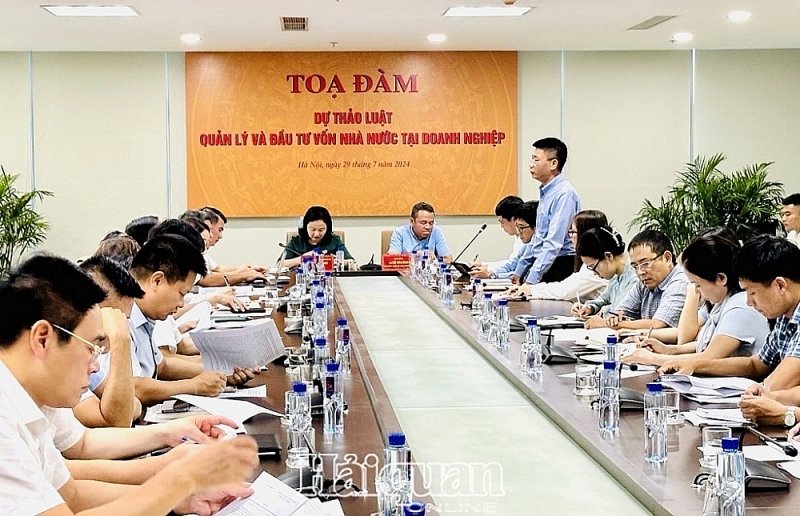 |
| a seminar on draft Law on Management and Investment of State Capital in Enterprises |
At a workshop held by the Ministry of Finance on July 29, 2024, to gather feedback on the draft Law on Management and Investment of State Capital in Enterprises, Mr. Nguyen Duy Long, Head of the General Policy Division of the Enterprise Finance Department, stated that to ensure the clear division and strong decentralization of responsibilities, the draft law stipulates that the state will manage invested capital through capital-owning representative agencies. These agencies will be responsible for managing capital in state-owned enterprises with direct state capital, while these enterprises will manage capital in other enterprises with state capital.
Regarding corporate management, Mr. Long noted that the draft law does not regulate the governance content of enterprises but only specifies the rights and responsibilities of state-owned enterprises. The draft law stipulates that state-owned enterprises have the autonomy to determine their own salary and bonus policies, without direct state intervention.
Salaries and bonuses should be linked to job responsibilities, production and business conditions, industry, nature of operations, labor productivity, and business performance, while ensuring market competitiveness. Enterprises may apply lump sum method for salary and bonus within the wage fund, provided that it is linked to the results and effectiveness of management, utilization, and state capital investment in the enterprise.
However, at the workshop, Mr. Dang Ngoc Hai, Deputy General Director of Hanoi Water Supply Joint Stock Company, expressed that the provision stipulating that salaries and bonuses for enterprise managers and supervisors be paid from after-tax profits after setting aside funds is not practical. Since these individuals directly manage enterprise operations, their salaries and remuneration should be considered legitimate expenses for income tax purposes.
Addressing this issue, Mr. Bui Tuan Minh, Director of the Enterprise Finance Department, clarified that the draft law does not regulate the salaries and bonuses of enterprise managers but only those of individuals appointed or introduced by the capital-owning representative agency. Additionally, salaries and bonuses can be paid from after-tax profits, or if insufficient, from the Investment Development Fund at the enterprise corresponding to the state capital contribution, or if the fund is insufficient, from the state budget of the capital-owning representative agency.
Mr. Minh noted that the draft law has considered three scenarios for preparing the salary and bonus fund for representatives of the capital-owning agency.
Furthermore, many enterprises raised concerns about profit distribution. According to a representative from the Urban Infrastructure Investment and Development Joint Stock Corporation (UDIC), following the practice of joint-stock companies and listed companies, a certain percentage of after-tax profits is usually set aside for bonus and welfare funds. Therefore, the draft law should specify a more detailed percentage to ensure consistency among enterprises.
Regarding the principle of profit distribution, Mr. Ngo Xuan Phu, a member of the Board of Directors of Hanoi Transport Corporation, suggested that payments for salaries of representatives appointed or hired by the capital-owning agency, as well as for audit reports, be included as legitimate expenses of the enterprise.
Mr. Ha Quy Sang, Head of the Enterprise Finance Department of Hanoi Department of Finance, argued that salaries and bonuses for representatives of the capital-owning agency should be included in the actual operating expenses of the enterprise and not taken from the Investment Development Fund at the enterprise, as this fund is set aside as a percentage of after-tax profits. This would create inconsistencies between enterprises with 100% state capital and those with less than 100% state capital.
Regarding the percentage of profit distribution to the Investment Development Fund at the enterprise, Mr. Sang suggested that a 100% set-aside rate should not be mandated. The principle of after-tax profit distribution should balance the interests of the state, the enterprise, and employees. Therefore, a portion of the profits should be retained by the enterprise for reinvestment and business expansion, while also ensuring a mechanism for employees to share in the results through bonus and welfare funds.