VIETNAM CHAMBER OF COMMERCE AND INDUSTRY
Liên Đoàn Thương Mại Và Công Nghiệp Việt Nam
Fri, Feb 20, 2026, 09:27:00
Full-year investment volumes reached $147.6 billion, climbing 12 per cent since 2024, the strongest year since 2021, capping a year of steady recovery against a turbulent macroeconomic and geopolitical backdrop, the report added.
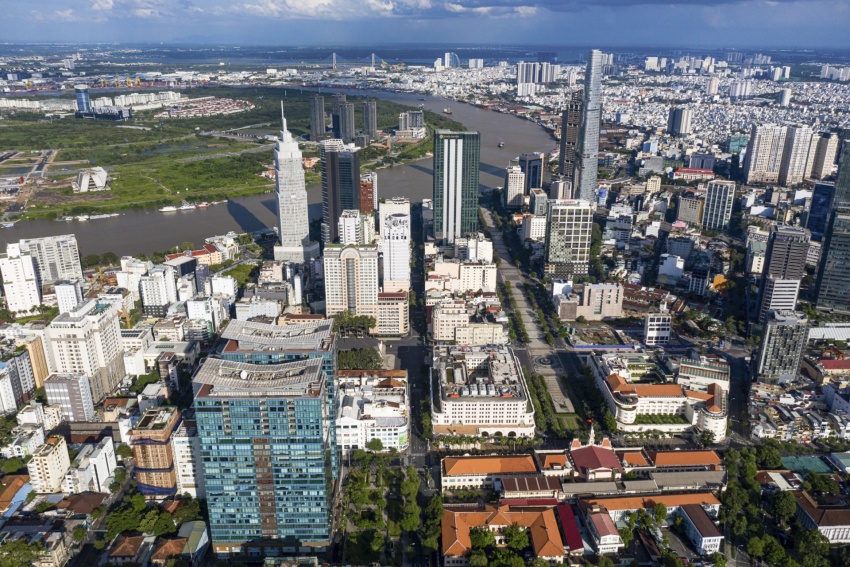 |
| Vietnam's commercial real estate investment market remains modest compared to other mature markets in the region. Photo: Le Toan |
Japan maintained its status as the region's most active market, recording $9.8 billion in investment volumes in Q4/2025, bringing the full-year total to $41.4 billion.
While investment volumes were down 9 per cent on-year in Q4, they rose by 14 per cent for the full year 2025.
Investment activity was supported by several high-profile sale-and-leaseback deals across office and industrial assets, with higher industrial volumes due to more development project exits.
South Korea meanwhile saw a surge in activity, with Q4 2025 volumes of $7.7 billion representing a 41 per cent on-year jump, bringing the 2025 FY total to $28.1 billion.
The Korean market was buoyed by strong domestic demand for core office assets and foreign investor interest in the logistics sector. High demand for hotels has pushed up prices, with investors scouring the market for value-added hotel opportunities.
"The strong year-end performance caps a year of steady recovery for Asia-Pacific's commercial real estate (CRE) markets. Despite a turbulent global backdrop, investment volumes have shown remarkable resilience, climbing 12 per cent for the year," said Stuart Crow, CEO, Asia-Pacific Capital Markets, JLL.
"We're seeing continued confidence from investors, evidenced by the sustained momentum in powerhouse markets like Japan and South Korea. A notable trend is the growing influence of regional capital, which is increasingly active in acquisitions across Asia-Pacific, complementing established global capital flows.”
Cross-border investment trends pointed to the increasing role of regional capital across Asia-Pacific.
While global capital continues to lead cross-border acquisitions into major markets such as Japan and Korea, capital from other Asia-Pacific sources is becoming more prominent in deal activity across the region. Singaporean capital is most active in Australia, with a number of significant acquisitions being made throughout the year.
The living sector captured a record share of CRE investment in 2025, with Asia-Pacific investment volumes rising 77 per cent on-year to $12.6 billion in 2025, representing 9 per cent of total CRE activity. Markets such as Japan, Singapore, Australia and Greater China were the most active markets in 2025.
In Vietnam, the commercial real estate investment market remains modest compared to other mature markets in the region.
However, according to JLL's records of publicly announced transactions, the real estate merger and acquisition market reached a record high in 2025 with total transaction value of approximately $2.5 billion.
The residential sector led the way, accounting for over 70 per cent of transaction volume.
Trang Le, country head, JLL Vietnam said that the policy allowing conversion of non-agricultural land to commercial residential projects from April 2025, together with improved infrastructure connectivity and policy reforms supporting economic growth, has created strong momentum for M&A activity amid increasingly limited supply of clean land.
In 2026, technology will be a significant catalyst for investment. The global boom in AI spending is expected directly to impact real estate by fuelling robust demand for data centres amidst Asia-Pacific’s robust pipeline and digitalisation initiatives, with investment volumes reaching $15 billion in 2025, according to JLL.
With the real estate market expected to benefit from broader economic growth across major markets and moderating inflation, the outlook for Asia-Pacific commercial real estate in 2026 is one of cautious optimism, fuelled by robust occupier fundamentals, emboldened investor confidence, and increasingly sophisticated capital deployment strategies spanning the region.
"As we enter 2026, we anticipate a more stable operating environment supported by improving market fundamentals. The boom in AI spending has infused a new layer of optimism into the global economy, and its impact on real estate demand will be a key theme to watch," said Pamela Ambler, head of Investor Intelligence, Asia-Pacific, JLL. "Furthermore, with expectations that debt costs may have bottomed out across many markets, investors will be keenly observing central bank policies. Monetary policy decisions, particularly from the Federal Reserve, will be crucial in shaping the investment landscape throughout the year.”