VIETNAM CHAMBER OF COMMERCE AND INDUSTRY
Liên Đoàn Thương Mại Và Công Nghiệp Việt Nam
Thu, Dec 21, 2023, 14:24:00
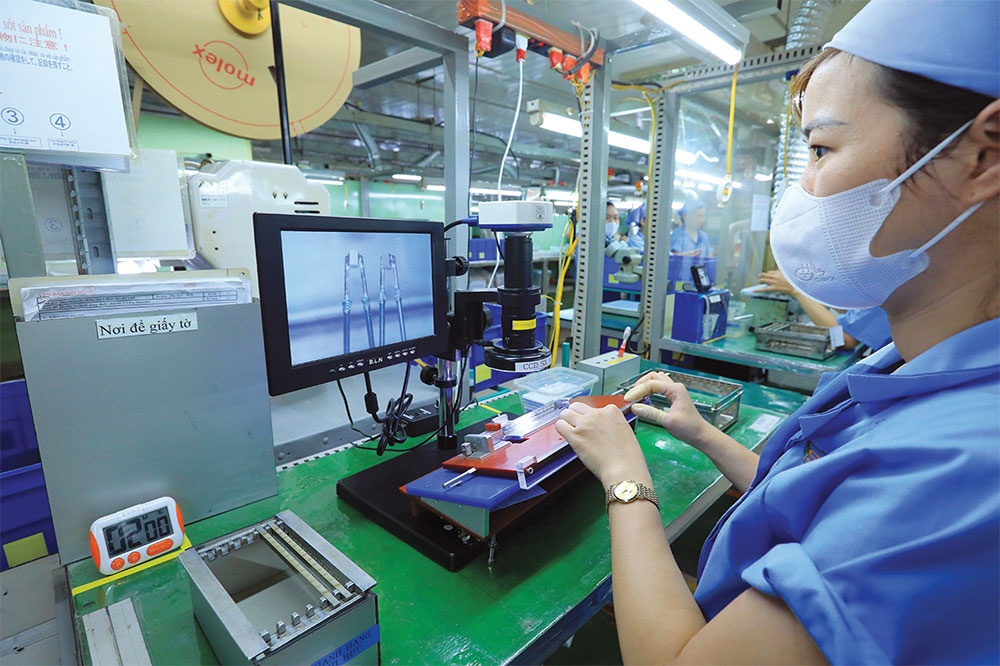
| Local authorities wish for an easier process when it comes to dealing with new projects of various sizes, photo Le Toan |
The Institute for International Investment Studies (ISC) is implementing a survey with cities and provinces across the country about the impact of Resolution No.50-NQ/TW on improving the quality and efficiency of foreign investment cooperation towards 2030.
As part of its work, in which surveys will be carried out every five years, the ISC is also working with localities to collect opinions to help build the specific criteria framework for attracting high-quality foreign-invested projects. The Central Party Committee has assigned the Central Economic Committee to make a report, with the latter ordering the ISC to conduct the surveys and build the criteria framework.
Over the past few weeks, the ISC has worked directly with departments of Nghe An, Ha Tinh, Vinh Phuc, and Hai Duong provinces, among others. In addition, they will implement online surveys with the rest of the localities to collect opinions.
ISC member Ngo Cong Thanh said that Resolution 50, which was issued in 2019, provided some important tasks, including formulating investment criteria for selecting areas given priority in conformity with local development orientations.
“In addition, it needs to establish criteria for assessing the efficiency of foreign funding in terms of economic, social, environmental, national defence and security aspects,” Thanh said. “Furthermore, it needs to improve regulations on management and supervision of foreign investments, providing for the responsibility of ministries and local governments to take charge and cooperate in management and supervision of such activities.”
However, four years after Resolution 50 came into being, specific criteria in this vein is unfinished. Meanwhile, although criteria to appraise foreign-invested projects was integrated into the laws on investment and the environment, application still has many limitations, Thanh explained.
“Meanwhile, through meeting with localities, especially emerging localities, it is found that they are waiting for the official criteria frameworks with specific guidelines so that they can attract large-scale projects with high-tech content,” Thanh said.
Hai Duong is just one example. The province reported a breakthrough in foreign-invested capital this year, and wants to continue to sharpen its focus on calling for large-scale non-labour-intensive ventures with advanced technologies and high-value products.
Nguyen Duy Hung, deputy director of Hai Duong Department of Planning and Investment, said, “Compared to the surrounding localities such as Quang Ninh, Haiphong, or Bac Ninh, our province is an emerging locality in attracting foreign capital. Thus, having specific criteria will help the province turn down labour-intensive projects and schemes that have a higher risk of environmental pollution, such as garments and textiles. In addition, the criteria will support us in appraising various initiatives.”
“During the investment promotion process, many foreign financiers express their intentions to put less than $5 million into projects. We are often perplexed about deciding to turn these types of ventures down due to a lack of criteria. We are then forced to report to provincial leaders for advice, and this lack of criteria means we are not proactive enough in filtering out unwarranted proposals,” Hung added.
The team at ISC also said that in the cities and provinces where they worked, the leaders of provinces and departments had the same opinion about the importance of issuing the specific criteria framework soon.
At both international and domestic forums, Vietnam’s leaders have emphasised that there should be innovative measures to attract investment from society, with a particular focus on selectively choosing foreign funding in large-scale and high-tech projects, especially in sectors like manufacturing and processing, electronics, semiconductors, and hydrogen.
Vietnam aims to attract half of the Fortune-listed 500 global largest corporations by 2030 and to be among ASEAN’s top three and the world’s top 60 countries in the World Bank’s Ease of Doing Business rankings.