VIETNAM CHAMBER OF COMMERCE AND INDUSTRY
Liên Đoàn Thương Mại Và Công Nghiệp Việt Nam
Tue, Jul 14, 2026, 14:41:00

Enhancing workforce skills and local production capabilities remains a priority for Vietnam's industrial development
However, the quality and effectiveness of attracting, managing, and utilizing foreign investment have yet to fully reflect Vietnam's potential and advantages or meet the development needs of the new stage.
Shift in development mindset
According to Party General Secretary and President To Lam, Resolution 10-NQ/TW, issued by the Politburo on June 8, 2026, on developing the foreign-invested economy reflects a shift in development thinking, moving beyond simply opening the door to foreign capital toward proactively selecting and leveraging international resources to strengthen national competitiveness.
Since the 1987 Law on Foreign Investment was enacted, and through successive amendments and improvements to the Investment Law, Vietnam has gradually strengthened its market economy institutions, expanded international integration, and built an increasingly open, transparent, and stable investment environment. This process has transformed Vietnam from a closed economy with limited capital and heavy reliance on international aid into a highly open economy deeply integrated with the region and the world. From accounting for only a small share in the late 1980s, international trade has grown to make Vietnam an important link in global production and trade networks, with total import-export turnover exceeding 180% of GDP, of which the foreign direct investment (FDI) sector accounts for about 75%. The foreign-invested sector has contributed to economic growth, exports, industrialization, job creation, technology transfer, and the adoption of modern management practices.
"Today, Vietnam is in a different position. We no longer ask how to attract more foreign capital. Instead, we must answer a more challenging question: how to use foreign resources effectively to strengthen domestic capabilities, technological capacity, competitiveness, and the economy's self-reliance," the Party General Secretary and President said.
Despite its achievements, FDI attraction still faces significant limitations. The localization rate remains low, while linkages with domestic enterprises, technology transfer, research and development, and high-quality workforce training have yet to meet expectations. Many foreign-invested projects continue to focus mainly on processing and assembly, relying heavily on land, low-cost labor, inexpensive energy, low environmental standards, or preferential incentives, without building new capabilities for the economy.
Of particular concern, some localities continue to compete for investment based on the number of projects by offering incentives on land, taxes, and fees, without giving sufficient attention to land-use efficiency, energy conservation, budget contributions, technology transfer, domestic business development, environmental protection, and economic security. Many regions also continue to lag in attracting foreign investment, including the Mekong Delta, the Central Highlands, and the Northern Mountainous Region.
To address these shortcomings, Resolution 10-NQ/TW sets higher goals and requirements. The development of the foreign-invested economy must go hand in hand with strengthening the economy's strategic self-reliance, production capacity, technological capabilities, and competitiveness. By 2030, Vietnam aims to rank among ASEAN's leading countries in the business and investment environment, competitiveness, innovation, public service quality, and the ability to attract high-quality foreign investment projects. The Resolution also sets a range of other specific targets.


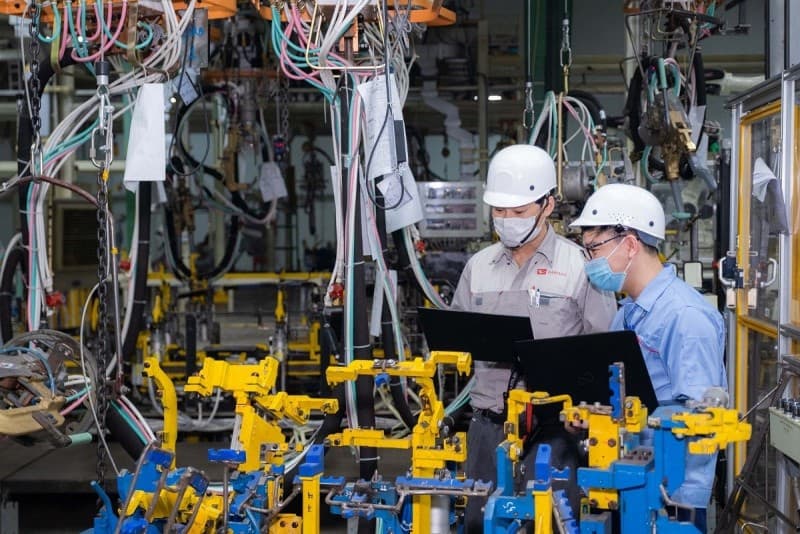
Stronger partnerships with global companies help Vietnamese firms adopt advanced technologies and modern management practices
Aligning on a new foreign investment strategy
According to Party General Secretary and President To Lam, achieving these goals requires a full understanding of Resolution 10-NQ/TW and a more decisive, faster, and more effective approach to foreign investment. Authorities at all levels, ministries, sectors, and localities need to focus on implementing several key tasks. First, they must build broad consensus and adopt a new mindset on foreign investment. The foreign-invested sector is an important part of the national economy, cooperating, competing fairly, and developing alongside the state, private, and cooperative sectors. Institutions must be strengthened to ensure stability, transparency, predictability, and alignment with international practices. Ministries and agencies must review and harmonize regulations on investment, business, and markets, while resolving overlapping and conflicting rules, cumbersome administrative procedures, and inconsistent implementation across agencies and localities.
In addition, Vietnam should move away from input-based incentives and instead provide support based on results and the fulfillment of commitments. Projects involving advanced technologies, investment in research and development, contributions to the green and digital transitions, workforce training, the use of domestic suppliers, technology transfer, efficient land and energy use, and emissions reduction should receive appropriate support.
Particular attention should be given to building a strong domestic industrial ecosystem and strengthening meaningful linkages between FDI enterprises and Vietnamese businesses. This is the Resolution's central task. Ministries, sectors, and localities should not only attract foreign corporations but also strengthen the capabilities of Vietnamese enterprises so they can become their suppliers. Greater efforts are also needed to develop high-quality human resources and invest more in strategic infrastructure and infrastructure for the new economy.
In addition, according to Party General Secretary and President To Lam, investment promotion must be fundamentally reformed. Instead of taking a broad, unfocused approach, Vietnam should pursue targeted engagement by carefully preparing for meetings with individual corporations, groups of corporations, investment funds, and strategic partners. Authorities must support investors from the initial exploration stage through implementation, operation, and expansion, while developing a modern capital market capable of attracting long-term, stable, and responsible portfolio investment.
"We are entering a new stage of development with a new mindset. Vietnam will not attract investment at any cost. It must become a country with a clear strategy, selective investment policies, the capacity to screen investments, and the ability to work with quality investors to create new value together. The spirit of Resolution 10 is very clear: attracting foreign investment is not meant to replace domestic strength but to reinforce it and strengthen self-reliance; not only to achieve rapid growth but also to secure sustainable, inclusive, and high-quality development," Party General Secretary and President To Lam said.
This is the most practical way for Vietnam to continue its renewal, integration, and development, enabling the country to move steadily toward becoming a developed, high-income nation by 2045.