VIETNAM CHAMBER OF COMMERCE AND INDUSTRY
Liên Đoàn Thương Mại Và Công Nghiệp Việt Nam
Fri, Aug 29, 2025, 09:42:00
In a proposal to the HCMC authorities, Thaco (OTC: THA) said the project aligns with its long-term strategy and that it has completed initial studies and documentation for review. If approved, Cai Mep Ha would mark the company’s second port investment, following Chu Lai port in the central province of Quang Nam.
Cai Mep Ha is part of the Cai Mep-Thi Vai port complex, designated in Vietnam’s national seaport development plan through 2030 as a key international gateway.
It is located at Tan Phuoc ward, HCMC (formerly Phu My township in Ba Ria-Vung Tau province). Ba Ria-Vung Tau, Binh Duong and HCMC were recently merged to form the new HCMC.
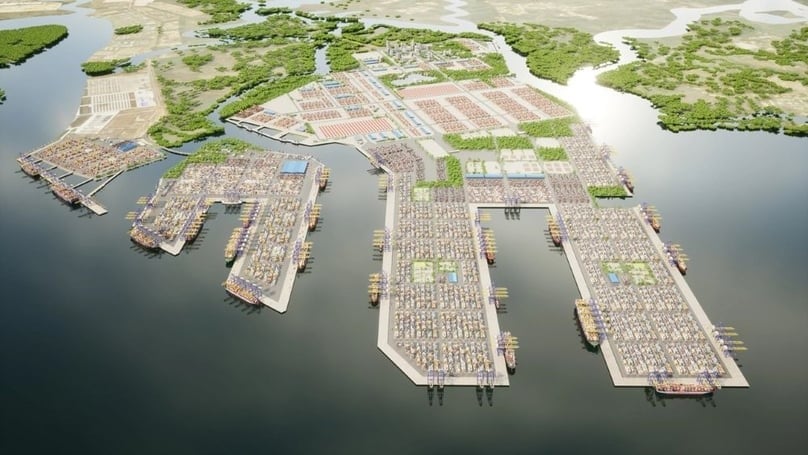 Illustration of the Cai Mep Ha container and general port project in former Ba Ria-Vung Tau province (now part of the new Ho Chi Minh City). Photo courtesy of the investor consortium.
The project has drawn interest from major investors over the years, including a Geleximco-ITC-SCIC consortium, IMG Innovations, Tan Dai Duong International, and Sun Group.
Under one proposal from the Geleximco-led group, the development would span 351 hectares of land with 17 terminals totaling nearly 5.9 km in length, capable of handling 10.8 million TEUs annually.
The plan also envisions container yards, warehouses, cargo irradiation facilities, and supporting infrastructure, with an estimated investment of VND50.8 trillion ($1.9 billion) over three phases.
The Cai Mep-Thi Vai complex currently hosts seven container terminals with a combined design capacity of 7.66 million TEUs per year. However, throughput has consistently outpaced that figure, averaging more than eight million TEUs annually in recent years and reaching a record 10.98 million TEUs in 2024, mostly from Cai Mep terminals.
According to the Ministry of Industry and Trade (MoIT), Vietnam’s logistics industry has grown at around 14-16% annually in recent years, with the market size in 2024 estimated to have exceeded $45 billion.
Notably, the World Bank (WB) ranked Vietnam 43rd out of 155 countries and territories in the Logistics Performance Index (LPI) and places it among the top five ASEAN countries, after Singapore, Malaysia, and Thailand, and at the same level with the Philippines.