Ho Chi Minh City (VNA) – Ho Chi Minh City is stepping up efforts to accelerate public investment disbursement after releasing just 10.5% of its 2026 capital plan in the first four months of the year, as the southern economic hub identifies public spending as an important driver for achieving its double-digit growth target.
The city was allocated a record 147.599 trillion VND (5.6 billion USD) in public investment capital for 2026, up 22.6% from last year and accounting for nearly 14.6% of the nation’s total public investment budget. However, disbursement by the end of April remained below the national average.
The municipal Department of Finance attributed the slowdown largely to the restructuring of the public investment management system and the reassignment of duties among agencies. City authorities said several major bottlenecks had already been addressed in April to pave the way for faster disbursement in the months ahead.
Speaking at a socio-economic conference on May 8, Vice Chairman of the municipal People’s Committee Hoang Nguyen Dinh called on agencies to move beyond a “target-oriented” mindset and ensure full disbursement of allocated capital in line with directives from the central government.
The city has ordered the swift consolidation of commune- and ward-level project management boards while tightening accountability among agency heads. Local authorities and project investors that fail to meet disbursement targets could face scrutiny during year-end performance reviews.
The Department of Finance has also urged departments, local administrations and investors to speed up capital allocation and disbursement, with the goal of reaching 30-35% of the annual plan in the second quarter and 100% for the full year.
Authorities said implementation must strictly follow the principle of clearly defined responsibilities, authority, timelines and outcomes, while intensifying field inspections and resolving bottlenecks related to planning, bidding, contractor selection and land clearance.
Land clearance remains one of the biggest hurdles for key infrastructure projects across the city. Ho Chi Minh City allocated 33.685 trillion VND in compensation funding for 165 projects this year, with around 8.614 trillion VND, or 25%, disbursed so far.
According to the municipal Department of Agriculture and Environment, many newly funded projects are still undergoing land recovery, surveys, inventory checks and legal verification procedures required under the 2024 Land Law, slowing overall progress despite the relatively higher disbursement rate.
The city aims to finalise compensation and resettlement plans in the third quarter to speed up payments and capital disbursement, while also strengthening steering committees and task forces to handle local bottlenecks more quickly.
Authorities in 168 communes, wards and special zones have been instructed to review all obstacles related to compensation and land clearance and proactively resolve issues within their authority to avoid delays caused by overlapping administrative procedures.
In addition to procedural bottlenecks, rising construction material costs are placing mounting pressure on major public investment projects. Higher fuel prices have increased the costs of mining and transporting sand and stone, as well as operating construction machinery.
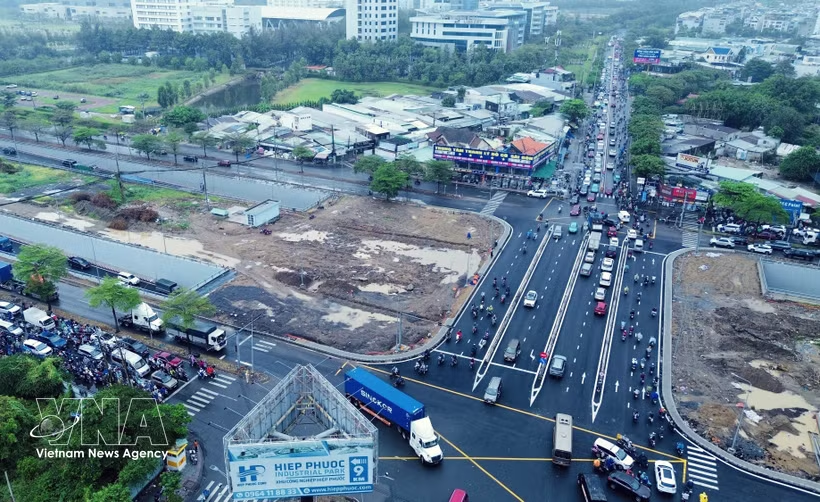
The Ring Road No.3 project in Ho Chi Minh City, one of southern Vietnam’s flagship infrastructure developments, is now projected to be delayed by around six months from the original schedule. The city’s Transport Works Construction Investment Project Management Board said the project has reached around 76% completion overall, with packages in the former Thu Duc city area at 83%, while those in Cu Chi, Hoc Mon and Binh Chanh have reached about 68%.
The management board cited fuel price volatility linked to escalating tensions in the Middle East, alongside shortages of imported bitumen and asphalt concrete, as major factors affecting construction progress.
Project investors and contractors are coordinating with quarry operators to secure additional material supplies while also calling for construction material prices to be updated more frequently in line with market movements to ease cost pressures.
With the largest public investment programme in its history, Ho Chi Minh City is expected to face significant disbursement pressure throughout 2026. However, officials believe that if bottlenecks involving land clearance, investment procedures and material supply are removed in a timely manner, public investment will continue to serve as a key growth driver for the city this year./.

VIETNAM CHAMBER OF COMMERCE AND INDUSTRY
Liên Đoàn Thương Mại Và Công Nghiệp Việt Nam