Ho Chi Minh City (VNA) – Vietnam is shifting its focus in foreign direct investment (FDI) attraction from quantity to quality under Politburo Resolution No. 10-NQ/TW on developing the foreign-invested economic sector, which also creates new requirements for industrial infrastructure.
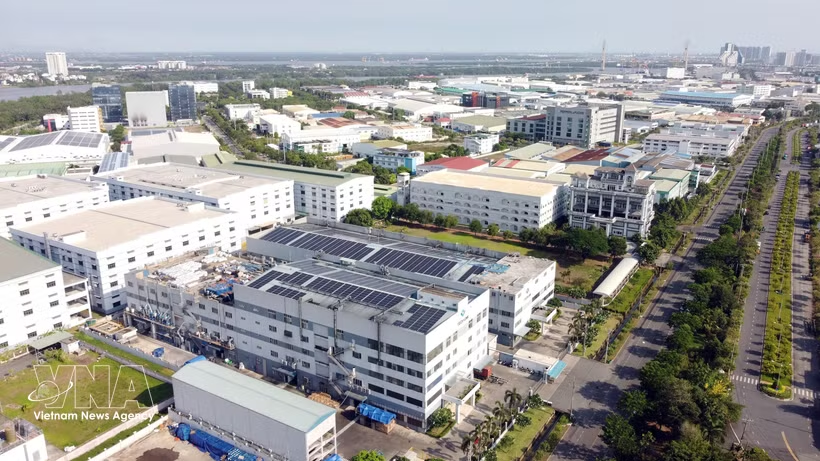
Investors are increasingly prioritising industrial parks that enable the rapid commencement of factory operations, feature efficient connections with manufacturing and logistics ecosystems, and comply with sustainable development standards.
In Ho Chi Minh City, KCN Vietnam has recently broken ground on the Song Than 3 Industrial Park project to meet rising demand for high-quality industrial infrastructure in southern Vietnam. Covering 21.9ha, the project will provide ready-built factories (RBF) and ready-built warehouses (RBH), designed and constructed to LEED green building standards. Upon completion, it is expected to add more than 130,000sq.m of high-quality, sustainable industrial space to the market.
Strategically located in Ho Chi Minh City – a long-established manufacturing and logistics hub, the project is expected to help businesses optimise production and goods circulation, enhance competitiveness and participate more deeply in global supply chains.
Hardy Diec, Chief Operating Officer of KCN Vietnam, said industrial infrastructure is increasingly becoming a key differentiator as Vietnam steps up efforts to attract high-quality FDI. Investors now consider not only rental costs but also strategic location, speed to operation, flexibility, sustainability and long-term business efficiency.
The group plans to complete additional projects in Dong Nai and Hai Phong cities in late 2026 and early 2027, adding more than 300,000sq.m of high-quality ready-built industrial space.
Following its administrative merger, the new Ho Chi Minh City has emerged as a major inter-regional megacity combining financial, industrial, innovation and seaport advantages. It is currently home to 105 planned export processing and industrial parks covering more than 50,288ha.
The city is restructuring its industrial space towards smart and eco-industrial park models while prioritising high-tech value chains. It is also shifting FDI attraction from traditional industries towards projects featuring core technologies and high added value, alongside digital and green transformation.
Nguyen Truong Thi, Deputy Director of the municipal Department of Industry and Trade, said strengthening Vietnamese firms’ participation in FDI and global supply chains while attracting high-quality foreign capital is crucial to sustainable industrial development.
Vo Son Dien, Chairman of the Ho Chi Minh City Association of Supporting Industries, noted that international enterprises are expanding investment in electronics, high technology, semiconductors and green manufacturing in Vietnam, reinforcing the country’s position as an important destination amid global supply chain restructuring.
Resolution No. 10-NQ/TW marks a major institutional breakthrough for Vietnam as it is the first time the development of domestic supply chain capacity has been placed at the centre of the country’s FDI policy. The resolution targets around 10,000 Vietnamese enterprises joining FDI supply chains and 500–1,000 Vietnamese Tier-1 suppliers in those chains by 2030, with the rate of domestically made components in key industries reaching 45–50%./.

VIETNAM CHAMBER OF COMMERCE AND INDUSTRY
Liên Đoàn Thương Mại Và Công Nghiệp Việt Nam