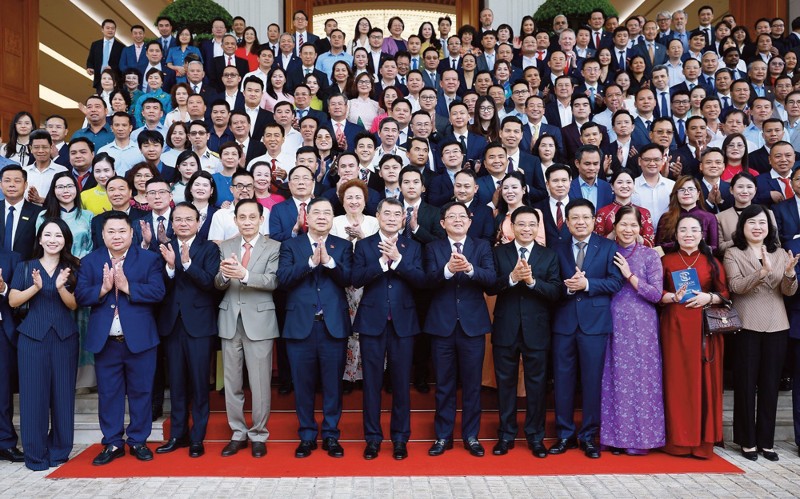
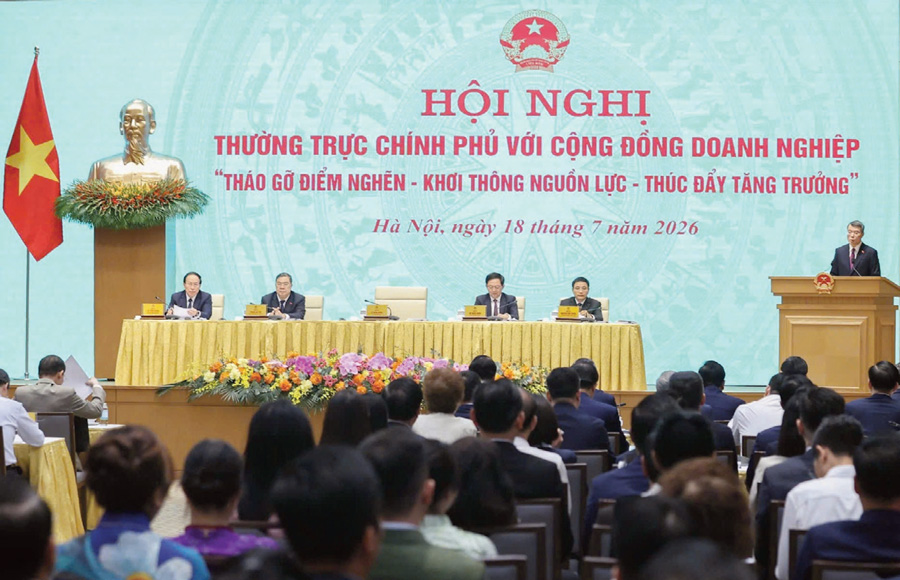
Vietnam’s drive to achieve sustained high economic growth took center stage on July 18, as Prime Minister Le Minh Hung convened the Government Standing Committee’s first high-level conference with the business community, bringing together leaders of ministries, localities, State-owned enterprises (SOEs), private corporations, foreign-invested enterprises (FIEs), and business associations to discuss the challenges and opportunities shaping the country’s next phase of development.
With the theme “Removing bottlenecks - Unlocking resources - Promoting growth,” the conference reflected the government’s determination to strengthen dialogue with the business community as Vietnam embarks on the first year of its 2026-2030 socio-economic development plan.
Against a backdrop of global geopolitical tensions, trade uncertainty, and rapid technological change, the discussions focused on how to sustain growth, enhance competitiveness, and unlock new drivers of development.
New growth agenda
Opening the conference, Prime Minister Le Minh Hung reaffirmed that businesses are at the center of Vietnam’s growth strategy, emphasizing that the government is committed to creating the most favorable conditions for enterprises to invest, innovate, and expand. He stressed that the objective is not merely to identify bottlenecks but to resolve them through more effective implementation, stronger coordination, and closer partnerships between the government and the business community.
The conference also provided a rare platform for businesses across different sectors to speak directly with policymakers, offering recommendations on issues ranging from institutional reform and access to capital to digital transformation, infrastructure, technology, and international competitiveness. Their perspectives, alongside responses from ministries and government agencies, offered a comprehensive snapshot of the opportunities and constraints facing Vietnam’s economy as it pursues its ambitious development goals.
Presenting the conference’s central report, Minister of Finance Ngo Van Tuan said Vietnam is entering a new phase of development as it embarks on the first year of its 2026-2030 socio-economic development plan. The new growth cycle begins against an increasingly complex global backdrop marked by geopolitical tensions, trade protectionism, supply chain restructuring, rapid advances in AI, and an accelerating green transition, all of which are reshaping the global economy and creating both opportunities and challenges for Vietnam.
Despite these headwinds, Mr. Tuan said Vietnam’s economy maintained positive momentum in the first half of 2026. Macro-economic stability has been preserved, inflation has remained under control, and major economic balances have been maintained, while industry, construction, services, tourism, exports, and foreign investment have continued to recover.
At the same time, the government has accelerated institutional reforms, administrative simplification, decentralization, and efforts to resolve longstanding projects to create additional room for growth.
The Minister said the business community has continued to demonstrate resilience despite global uncertainty. As of the end of June, Vietnam had nearly 1.062 million active enterprises with total registered capital of more than VND30,600 trillion (about $1.18 trillion). Businesses now contribute more than 60 per cent of GDP, employ over 17.6 million workers, and account for the majority of the country’s total import-export turnover.
During the first half of the year, nearly 170,000 enterprises entered or re-entered the market, up 11.2 per cent year-on-year, including almost 111,700 newly-established businesses, an increase of 22.5 per cent. Newly-registered capital stood at approximately VND1,400 trillion (about $53.8 billion), up 64.8 per cent against the same period last year.
However, Mr. Tuan emphasized that achieving the country’s ambition of sustained double-digit growth in the years to come will require more than maintaining macro-economic stability.
Vietnam, he continued, needs to shift from improving its business environment to creating national competitive advantages, and from simply supporting businesses to empowering them to grow. Unlocking capital, land, technology, infrastructure, skilled labor, and markets, while strengthening links between SOEs, private enterprises, and FIEs, will be essential to building a more competitive and resilient economy.
The report also acknowledged that businesses continue to face significant obstacles, including difficulties in accessing capital, land, and high-quality human resources, rising operating costs, increasingly stringent global sustainability requirements, and poor domestic supply chain links.
Yet its most notable conclusion was that many of these challenges no longer stem from a lack of policies, but from shortcomings in implementation; a theme that would recur throughout the conference as business leaders shared their recommendations with the government.
Seeking greater autonomy
For many of Vietnam’s largest corporations, the government’s double-digit growth target is achievable only if businesses are given greater freedom to invest, innovate, and mobilize capital at scale. While each enterprise highlighted challenges specific to its industry, their proposals converged on a common message: the next phase of reform should focus on empowering businesses to lead growth rather than simply removing obstacles.
Speaking on behalf of the technology sector, Mr. Tao Duc Thang, Chairman and General Director of Viettel, argued that SOEs should evolve beyond their traditional commercial role to become national champions capable of leading strategic industries. He called for mechanisms that would enable leading enterprises to take on national missions in areas such as advanced technology, digital infrastructure, semiconductor development, and international expansion.
Rather than measuring SOEs solely by financial performance, he believes they should also be evaluated on broader contributions, including technology commercialization, domestic procurement, supplier development, and the growth of local industrial ecosystems.
Mr. Le Ngoc Son, Chairman of PetroVietnam, emphasized that achieving sustained double-digit growth will require a stronger legal and institutional framework for energy investment. He urged the government to accelerate reforms to the Law on Petroleum and the Law on Electricity, remove bottlenecks affecting major oil, gas, and offshore renewable energy projects, and establish a strategic national energy reserve to strengthen long-term energy security.
Beyond sector-specific reforms, he also called for greater decentralization and governance flexibility for SOEs, arguing that large corporations should be entrusted with greater decision-making authority while playing a leading role in linking domestic private companies with foreign investors through major energy projects.
Mr. Nguyen Thanh Tung, Chairman of Vietcombank, warned the conference that Vietnam’s growth ambitions are beginning to outpace the country’s domestic savings capacity. With investment requirements expected to exceed domestic capital formation, he argued that commercial banks alone will be unable to finance the next wave of large infrastructure and industrial projects. Instead, Vietnam will need to deepen its capital markets, develop a stronger corporate bond market, and mobilize more international financing, including through sovereign bond issuances, to bridge the widening investment gap.
Meanwhile, Ms. Nguyen Thi Nga, Acting Chairwoman of the Vietnam Private Business Association, Chairwoman of the BRG Group, and Permanent Vice Chairwoman of SeABank, highlighted opportunities to unlock new sources of growth beyond manufacturing and exports. She called for stronger policy support for green finance, noting that green credit remains a small share of total lending despite rapid growth.
She also proposed measures to strengthen domestic supply chains by improving links between manufacturers, distributors, and retailers, while positioning tourism, retail, and the night-time economy as new engines of domestic demand capable of generating higher value-added growth.
Those proposals reflected a broader shift in the priorities of Vietnam’s largest enterprises. Rather than seeking broad-based incentives, they called for reforms that would enable them to invest more confidently, mobilize larger pools of capital, and generate wider spillover effects across the economy.
New investment era
For foreign investors, Vietnam’s appeal is no longer defined solely by competitive labor costs or preferential investment policies. As global supply chains become increasingly technology-driven, business leaders said the country’s next competitive advantage will depend on its ability to provide a stable policy environment, develop skilled talent, and strengthen domestic industrial capabilities.
Speaking on behalf of the Japanese business community, Mr. Tsuchibashi Akito, Chairman of the Japanese Chamber of Commerce and Industry in Vietnam (JCCI Vietnam), said Vietnam has the potential to become one of Asia’s leading manufacturing hubs, but sustaining that momentum will require continued investment in human capital and stronger domestic supply chains.
He noted that Japanese manufacturers are increasingly seeking to source components locally, yet many Vietnamese suppliers still face constraints in technology, quality standards, and workforce capabilities. To bridge that gap, he called for closer collaboration between businesses, educational institutions, and government agencies to develop workplace skills, while expanding support for supplier development, R&D, technology adoption, and business matching.
Mr. Ko Tae Yeon, Chairman of the Korea Chamber of Business in Vietnam (KoCham), echoed many of those priorities, emphasizing that policy predictability and consistent implementation have become just as important as investment incentives.
While welcoming the government’s ongoing administrative reforms and open dialogue with the business community, he said businesses continue to face inconsistencies in the application of regulations across ministries and localities, as well as delays in customs procedures and VAT refunds. Mr. Ko also urged policymakers to view FIEs as an integral part of Vietnam’s economy rather than as a separate sector.
Despite highlighting the remaining challenges, business groups reaffirmed their long-term confidence in Vietnam as an investment destination. Rather than calling for additional incentives, they focused on the institutional reforms needed to support the country’s transition toward higher-value manufacturing and innovation.
Business expectations
While business leaders raised concerns ranging from energy security to capital markets and industrial competitiveness, the Vietnam Chamber of Commerce and Industry (VCCI) argued that many of those issues ultimately point to the same underlying problem: implementation.
Summarizing nearly 900 recommendations submitted by domestic and foreign enterprises, industry associations, and major corporations, Mr. Ho Sy Hung, President of VCCI, said the Chamber had consolidated the feedback into 53 groups of bottlenecks across ten areas.
Though ministries had responded to 51 of those issues, he said businesses continue to face significant barriers because many reforms have yet to be translated into consistent action on the ground. “The 53 bottlenecks can essentially be distilled into one issue,” Mr. Hung said. “Resources can still flow, but overall outcomes continue to be eroded by the cost of uncertainty.”
He described regulatory uncertainty as an “invisible cost” for businesses, citing legal gaps that arise when existing regulations are repealed before replacement rules take effect, as well as frequent policy changes without adequate transition periods.
While acknowledging the government’s responsiveness, Mr. Hung said many ministerial replies focused on explaining existing regulations rather than addressing implementation shortcomings. Businesses, he argued, are looking not only for policy clarification but also for clear roadmaps, designated lead agencies, and measurable timelines for resolving outstanding issues.
To improve accountability, VCCI proposed introducing implementation performance indicators for ministries and local authorities, alongside business satisfaction surveys and direct feedback channels to monitor how policies are carried out. It also called for assigning a single lead agency to coordinate the resolution of cross-sector issues, replacing fragmented approval processes with what Mr. Hung described as “one focal point, one process, and one outcome” for businesses.
Beyond removing bottlenecks, VCCI urged the government to stimulate demand by expanding export opportunities through free trade agreements and strengthening links between SOEs, FIEs, and domestic private enterprises. Large State-owned corporations, Mr. Hung said, should play a greater role as anchor customers, while foreign investors should deepen localization efforts and Vietnamese private enterprises should be better integrated into domestic and global supply chains.
More than any individual proposal raised during the conference, VCCI’s assessment captured a recurring theme that ran through discussions across industries and business groups. For many participants, Vietnam’s challenge is no longer designing new policies, but ensuring that existing reforms are implemented consistently, coordinated effectively, and measured by tangible outcomes rather than legislative intent alone.
Empowering the broader private sector
While large corporations focused on strategic investments and foreign investors emphasized competitiveness, Vietnam’s business associations drew attention to the practical challenges confronting the country’s broader private sector. Their message was consistent: the policy direction is largely in place, but stronger implementation is needed to translate reforms into tangible business growth.
Mr. Nguyen Van Than, Chairman of the Vietnam Association of Small and Medium Enterprises, welcomed the government’s recent efforts to support the private sector. He expressed hope that further tax reforms would encourage more household businesses to formalize their operations and grow into small and medium-sized enterprises (SMEs).
Rather than calling for sweeping new policies, Mr. Than argued that the priority should be decisive execution. He proposed assigning concrete development targets to SMEs and household businesses as part of Vietnam’s broader growth agenda, while calling for legal recognition of sole-proprietor enterprises under the forthcoming revised Law on Support for Small and Medium-sized Enterprises. He also advocated piloting independent credit-rating systems for SMEs to improve access to financing and expanding the Association’s organizational network to better support businesses at the local level.
Mr. Dang Hong Anh, President of the Vietnam Young Entrepreneurs Association, likewise focused on improving policy implementation. He proposed establishing a centralized digital platform to monitor the handling of business recommendations, enabling companies to track progress, identify responsible agencies, and improve accountability. He also called for cross-ministerial taskforces to tackle persistent bottlenecks.
Access to finance also remained a common concern. Mr. Hong Anh urged policymakers to expand lending models for SMEs and startups based on cash flow, contracts, and business performance rather than relying primarily on collateral, while advocating more predictable land rental policies and faster State divestment from equitized enterprises to unlock additional resources for private sector development.
Taken together, the Associations’ proposals reflected the day-to-day realities facing thousands of Vietnamese businesses. While the country’s largest corporations discussed strategic industries and foreign investors emphasized global competitiveness, SME representatives highlighted a more fundamental challenge: ensuring that reforms are implemented consistently, administrative bottlenecks are removed, and smaller enterprises have the confidence and support needed to expand.
From dialogue to delivery
Closing the conference, Prime Minister Le Minh Hung acknowledged that businesses had put forward a broad range of constructive recommendations, many of which extended beyond individual corporate interests to address broader structural challenges facing the economy.
While ministries had already responded to most of the 53 groups of bottlenecks compiled from nearly 900 submissions by businesses and associations, he emphasized that resolving them, not merely acknowledging them, would now become a government priority.
The Prime Minister instructed ministries, agencies, and local authorities to immediately resolve issues that fall within their legal authority, while proposals requiring legislative changes or higher-level approval should be submitted as quickly as possible.
To strengthen accountability, he said all ministerial responses to business recommendations would be published on the Government Portal and the websites of the Ministry of Finance, Ministry of Justice, and VCCI, allowing businesses and the public to monitor whether concerns had been addressed satisfactorily.
Prime Minister Hung acknowledged that many business concerns stem not from a lack of policy but from inconsistent implementation. Referring to instances where agencies simply cite existing laws without resolving underlying problems, he said transparency and public accountability should replace generic responses. “Making everything public is the best way for us to supervise and evaluate effectiveness,” he said, adding that ministries and localities must take responsibility for seeing issues through to completion rather than providing procedural explanations.
While reaffirming the government’s commitment to building a transparent, stable, and business-friendly investment environment, the Prime Minister also challenged enterprises to play a more active role in the country’s development.
SOEs, he said, should become genuine leaders in strategic industries, digital transformation, and innovation, while creating opportunities for domestic suppliers. Private enterprises must strengthen governance, technology adoption, and competitiveness, with larger corporations supporting smaller businesses through broader industrial ecosystems. FIEs, meanwhile, were encouraged to deepen technology transfer, develop Vietnamese suppliers, and expand R&D activities in Vietnam.
Looking ahead, the Prime Minister outlined six broad priorities for the government, including further institutional reform, improving access to capital, reducing business costs, promoting innovation and digital transformation, strengthening links between SOEs, private enterprises, and FIEs, and reinforcing administrative discipline to ensure policies are implemented consistently across all levels of government.
Throughout those priorities, one message remained constant: economic institutions should evolve from simply removing obstacles to becoming a stronger foundation for long-term development.
That message echoed the dominant theme running through the conference. Whether representing multinational corporations, domestic conglomerates, industry associations, or small businesses, participants broadly agreed that Vietnam’s policy direction is largely in place.
The next stage of reform will depend on execution - delivering clearer rules, more consistent implementation, and measurable outcomes that enable businesses to invest with confidence. As Vietnam pursues sustained double-digit growth, the success of that agenda may ultimately be determined not by the number of new policies introduced, but by how effectively existing commitments are translated into action.