VIETNAM CHAMBER OF COMMERCE AND INDUSTRY
Liên Đoàn Thương Mại Và Công Nghiệp Việt Nam
Wed, Aug 26, 2026, 14:36:00
Geleximco recently submitted its proposal to the government and local authorities as the country faces growing demand for construction materials for infrastructure development.
The firm estimates that Hai Phong and Hung Yen would require about 561 million cubic meters of construction and land-filling materials by 2030, while supplies of natural river sand are becoming increasingly constrained. Tighter controls on river-sand extraction are also needed to limit erosion and environmental damage, the company said.

The company has been working with Dutch maritime services group Boskalis since 2019 to study technology for dredging, screening, washing, desalinating and transporting marine sand.
Since 2023, Geleximco has also worked with relevant authorities to assess the use of marine sand in infrastructure projects. Initial surveys indicate that marine sand could potentially be used for land reclamation and certain construction applications after screening, washing and reducing its salt content, subject to technical standards and environmental requirements.
Geleximco, therefore, is proposing to study an industrial, logistics and port complex covering about 800 hectares in Hai Phong's Lach Huyen port, including strategic storage and handling facilities for construction sand.
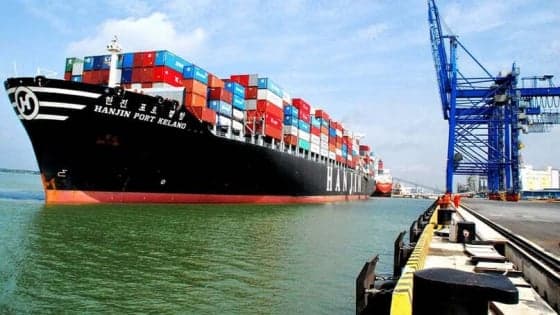
The proposed site will be located on reclaimed land within the planned areas for berths 19 and 20, which are intended for container cargo, and berths 21 and 22, which are planned to handle liquid cargo, as well as a logistics area behind the port.
The proposed sand terminal would receive, store, and transfer marine sand while also supporting ground improvement work at the reclaimed site.
Geleximco plans to develop the project in two phases. The first would focus on the sand terminal, including storage yards and infrastructure for receiving, transferring, and stockpiling marine sand to meet construction demand in Hai Phong, Hung Yen, and surrounding areas.
The company is also studying whether stockpiled sand could be used as surcharge loads to accelerate consolidation of soft ground in reclaimed areas, in combination with other ground-treatment measures. The feasibility of the approach would depend on geological surveys, engineering calculations, and environmental assessments.
Once the ground has been treated, the second phase would involve development of the port, industrial, and logistics complex.
The company is also seeking to expand the study to the Diem Dien port area in Hung Yen, potentially creating two hubs for receiving, storing, and transferring marine sand extracted from offshore areas of the Gulf of Tonkin.
The Diem Dien port area will cover about 221.38 hectares under the current planning and is designated for general cargo, specialized cargo ,and related infrastructure and services.
By 2030, the area is planned to handle about 6.8 million to 7.85 million tons of cargo a year, with 10-11 new berths. Offshore port areas are expected to be capable of receiving vessels of up to 50,000 DWT.
Geleximco said the two locations could form an interconnected network for handling and distributing marine sand, while also supporting the development of industrial and logistics infrastructure in northern Vietnam.
The company first reported to the Prime Minister in December 2025 on a plan to develop offshore sand resources as an additional source of construction materials for infrastructure projects.
It has asked for approval from central agencies, Hai Phong, and Hung Yen authorities to conduct further research, surveys, and prepare a project proposal in the third quarter of 2026.