VIETNAM CHAMBER OF COMMERCE AND INDUSTRY
Liên Đoàn Thương Mại Và Công Nghiệp Việt Nam
Mon, Dec 22, 2025, 14:26:00
In the increasingly fierce global race of emerging technologies, basic science and innovation have become pivotal factors. The history of every technological revolution—from Artificial Intelligence (AI) and semiconductors to UAVs and telecommunications—has originated from fundamental discoveries.
Reality has proven that for any enterprise or nation mastering basic science, developing a technological ecosystem becomes relatively favorable and within reach. In Vietnam, CT Group is one of the few enterprises choosing this "root-based" development path. For many years, the group has invested in basic science, established laboratory systems and R&D centers, and gathered a team of thousands of leading experts.
The distinction of basic science at CT Group lies in its focus on practical application to solve core problems for specific industries and the nation. Examples include:
• Dynamic models optimizing UAV stability.
• Data science and applied mathematics serving as the foundation for AI algorithms in UAV control, traffic forecasting, and resource-environmental monitoring.
• Molecular biology laying the groundwork for biomedical technology and precision agriculture.
Scientific pillars such as physics, chemistry, biology, applied mathematics, and dynamics have formed a methodology to improve technology, enabling new tech industries to "bud". Consequently, CT Group has become one of the rare enterprises capable of mastering 9 core 4.0 technologies: Semiconductors, AI, UAVs, Green Cryptocurrency, Carbon Credit Exchanges, Robotics, Quantum Computing, New Energy, and Gene & Cell therapy.
A key differentiator is that the group's industries do not develop in isolation but support one another. This synergy facilitates the birth of new core technologies. A prime example is the National Digital Twin 15 (NDT 15) technology, developed by combining UAVs, AI, data technology, and others. This is a superior tool for managing megacities and nations, making smart urban planning feasible with 300 data sources synchronized across 15 layers to serve comprehensive national digital transformation.
Based on advancements in NDT 15, UAVs, AI, and semiconductors, GASCO (a member of CT Group) successfully established the "Marginal Space Economy" theory. This multi-layered economic structure operates below an altitude of 3,000 meters, where human and machine activities are mapped into space with significantly higher productivity.
New technological combinations are constantly being formed:
• UAV-Carbon Credits: High-precision measurement of forest carbon and agriculture for the national carbon market.
• UAV-Semiconductors: Autonomy in chips and systems for specialized missions, ensuring data security.
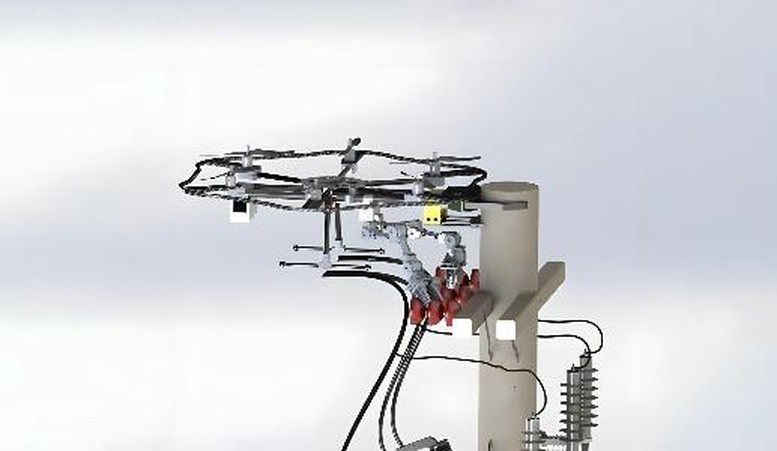
• Robotics-UAV: Flying robotic arms for high-precision tasks in specialized conditions.
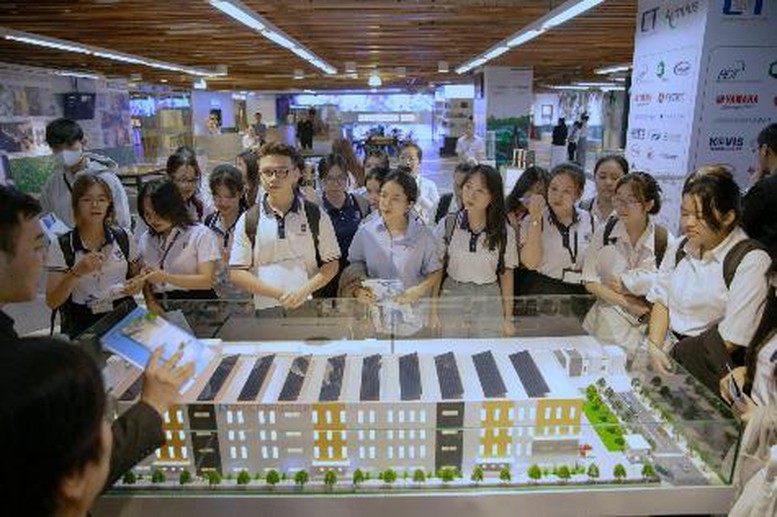
While basic science is the foundation, innovation is the engine for growth and socio-economic development. A strategic initiative is the CT Innovation Hub 4.0. Operating entirely on Web3 and AI, it represents a major leap over traditional startup centers. Crucially, its core is built on Blockchain to ensure uniqueness and protect intellectual property for ideas.
In the long term, CT Innovation Hub 4.0 aims to become a "Super Innovation University" on a Web3 platform, where learning is tied to value creation and immediate earning potential.
With a solid foundation in basic science and a strong capacity for innovation, CT Group has successfully implemented an ecosystem of core technology products in Vietnam. Furthermore, the group is venturing into outer space through CT VERSE, researching Vietnam's first 100kg satellite slated for 2026.