VIETNAM CHAMBER OF COMMERCE AND INDUSTRY
Liên Đoàn Thương Mại Và Công Nghiệp Việt Nam
Wed, Feb 15, 2023, 15:29:00
Electricity of Vietnam (EVN) suggested to the Ministry of Industry and Trade (MoIT) two weeks ago that the price of power transmission be increased to 0.3 US cents per kWh. EVN believes that this adjustment will assist National Power Transmission Corporation (EVNNPT) in reducing losses, maintaining its credit rating, ensuring obligations with borrowing organisations, and continuing to raise capital for investments in the construction of the power transmission system.
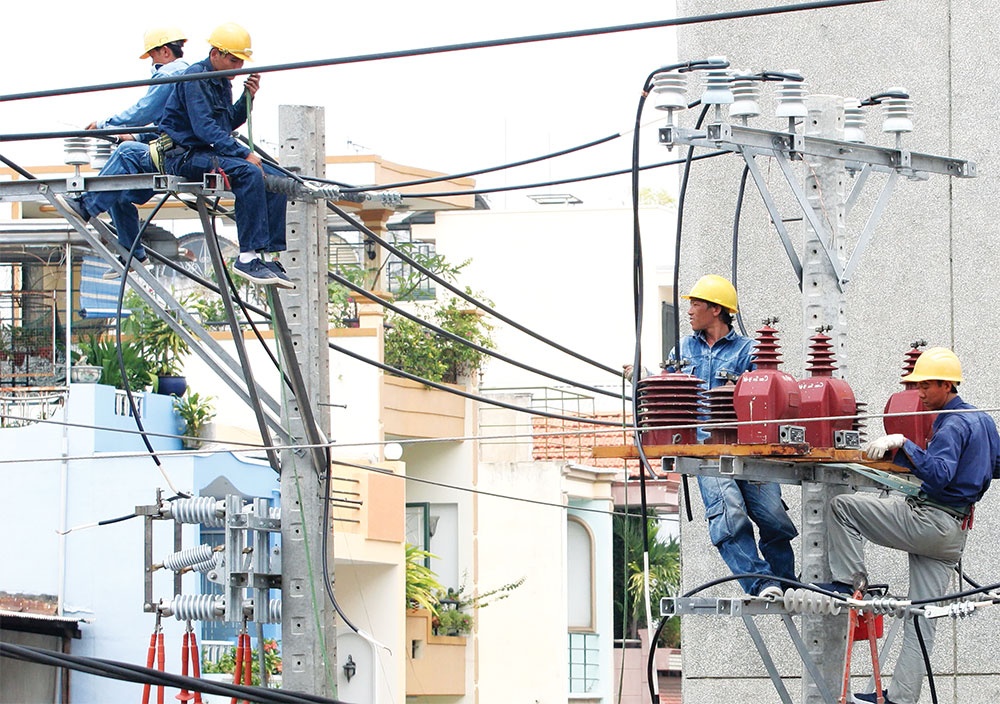
| Fresh approaches sought for electricity transmission, photo Le Toan |
The price of electric utilities, one of the components of the cost of power, is changed yearly. The MoIT has authorised a transmission tariff of 0.3 US cents per kWh for 2022, based on criteria such as the estimated transmission power production of 216,033 billion kWh, which is much higher than the actual EVNNPT output of 211.47 billion kWh.
In 2022, EVNNPT lost nearly $29 million, primarily due to the exchange rate difference and the fact that the transmission output was not updated in the MoIT transmission price plan approved in May 2022. Other costs were incurred with a transmission price of 3 US cents per kWh, and EVNNPT’s return on equity was zero.
Vietnam must raise the transmission cost from 22.37 to 52.9 per cent, based on the capital level of participation of non-state economic sectors and data from the Vietnam Initiative for Energy Transition Social Enterprise for 2022.
The state owns a transmission monopoly in Vietnam, according to the Law on Electricity of 2018. Do Duc Hung, planning director at EVNNPT, said it operates most of the transmission system infrastructure, comprising 178 substations and more than 28,600km of transmission lines.
“Unidentified investment criteria have caused a delay in the execution of power grid projects for the next few years, particularly those that must be operational beyond 2025-2030,” Hung said.
In 2023, EVNNPT is projected to invest around $816 million to enhance transmission power production by 2.97 per cent compared to 2022, reaching approximately 217.8 billion kWh, which is comparable to 35 projects commencing and concluding and 44 power grid projects coming online.
Vietnam requires a substantial amount of capital to rectify the situation in which the development of power sources is incompatible with distribution and load growth, resulting in an imbalance between supply and demand in each region and putting pressure on transmission up and down the country. According to the draft Power Development Plan VIII (PDP8), the transmission network would require an annual investment of approximately $1.44 trillion between 2021 and 2030, which is 1.8 times the 2016-2020 level.
The MoIT has released a circular outlining the transmission price calculation process and has applied it clearly to all participating investors. The PDP8 also includes a list of grid projects that need investment and defines the locations of several transmission works, such as the 500kV grid and substation, for which permission is required.
Several other economic sectors invest in distribution networks in metropolitan areas, industrial zones, and municipalities, although the volume and voltage level of these investments are quite limited. During 2019-2020, certain private investors invested in transmission lines, including Trung Nam Group in Ninh Thuan province and Xuan Thien Group in Dak Lak province. They invested in 220 out of 500kV transmission lines and substations, but primarily provided electricity transmission service from the plant they invested in to EVN’s connection point.
Bui Quoc Hung, deputy director of the Electricity and Renewable Energy Authority, said that the private sector will not engage in power transmission due to lack of interest. He said that the estimated rate of return on EVNNPT is very low, barely 3 per cent per year, and that private investors “find it difficult to accept” this rate.
“In Vietnam, the transmission price is controlled at a consistent rate. However, since the transmission works are located in various areas, the construction costs would vary. Private businesses could lose their investment if the project were not connected to the power plant and could not produce transmission output,” Hung added.
Private investors such as Trung Nam and Xuan Thien may recoup transmission investment expenses via power sales contracts to EVN or from other investors subleasing the transmission line to the connecting point.