VIETNAM CHAMBER OF COMMERCE AND INDUSTRY
Liên Đoàn Thương Mại Và Công Nghiệp Việt Nam
Fri, Aug 14, 2026, 14:56:00
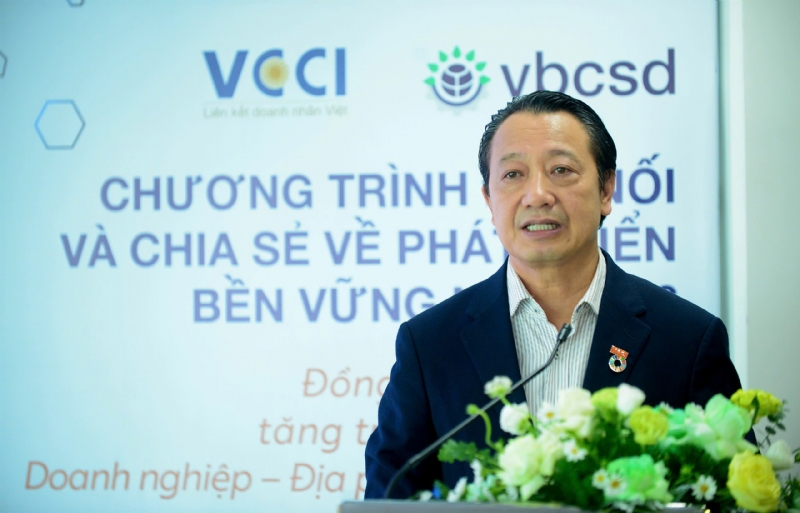
VCCI Vice President and VBCSD Chairman Nguyen Quang Vinh speaks at the 2026 Sustainable Development Dialogue
At the 2026 Sustainable Development Dialogue, themed “Partnering for Sustainable Growth: Businesses - Localities - Nation,” organized by the Vietnam Business Council for Sustainable Development (VBCSD) under the Vietnam Chamber of Commerce and Industry (VCCI) on August 6 at Bong Sen Factory in Hung Yen, participants discussed bottlenecks in cooperation among the government, businesses and schools and ways to move from separate efforts toward joint value creation.
Where are the bottlenecks?
According to Nguyen Hoa Cuong, Deputy Director of the Institute for Policy and Strategy Studies under the Party Central Committee’s Policy and Strategy Commission, the first barrier is not a lack of policy direction but consistency in understanding and implementation. Resolutions on science and technology, innovation and attracting high-quality foreign direct investment (FDI) can only be put into practice when their objectives are understood consistently by policymakers, ministries and agencies, local authorities and the business community.
Under Resolution 10-NQ/TW on developing the foreign-invested economic sector, the goal is not only to attract more capital but also to improve the quality of investment, prioritize high technology and modern management, and strengthen links with the domestic economy. However, if policies are not translated into practical mechanisms and action programs suited to each locality, the goal of increasing FDI spillovers will be difficult to achieve.
At the enterprise level, a major bottleneck is the relationship between the FDI sector and Vietnamese businesses. Nguyen Quang Vinh, Vice President of VCCI and Chairman of VBCSD, said Vietnam needs to shift from attracting FDI based on quantity to focusing on quality and spillover capacity. The target of having 10,000 Vietnamese enterprises join supply chains in Vietnam by 2030, including 500 directly participating in Tier-1 supply chains, requires FDI enterprises not only to set up factories in Vietnam but also to help strengthen the capabilities of domestic suppliers.
In reality, the presence of FDI enterprises does not automatically create strong supply-chain links. Technology transfer, sharing of management experience and support for domestic enterprises in meeting global supply-chain standards remain limited. This gap makes it harder for Vietnamese enterprises to move up the value chain, while FDI enterprises have yet to fully tap the potential of local supply ecosystems.
Another bottleneck is human resources and innovation capacity. VCCI Vice President and VBCSD Chairman Nguyen Quang Vinh described the quality of human resources as a “pain point” for the economy, as goals in AI, semiconductors, science and technology, and innovation cannot be achieved without people with the right management capabilities and skills.
From the education sector, Assoc. Prof. Bui Trung Thanh, Rector of Hung Yen University of Technology and Education, said training cannot be separated from business demand. If businesses only accept students after graduation without participating in curriculum development and research and development (R&D), the gap between training and production practices will remain difficult to close.
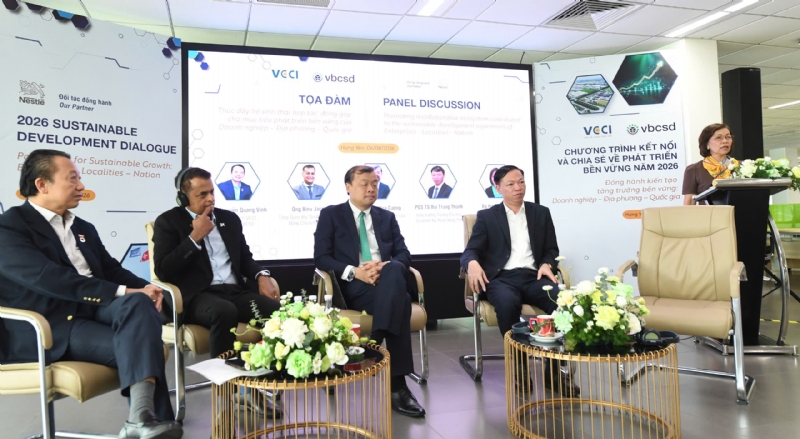
Participants discuss ways to turn government-business-university cooperation into practical action, strengthen business links and align training with market needs
From the three-stakeholder collaboration to co-creation
According to Nguyen Hoa Cuong, addressing these bottlenecks first requires a shift from issuing policies to implementing them. Each locality must identify its own strengths and needs, translate policy directions into specific measures, and create mechanisms for businesses to participate in policy development and implementation.
Within this ecosystem, authorities should not only act as regulators but also create a favorable environment for businesses and schools to work together. Regular dialogue among the parties, rather than communication only at events, can help identify bottlenecks early and turn agreed issues into concrete action.
For FDI enterprises, an important requirement is to move from being investors to becoming development partners of localities and supply chains. Binu Jacob, CEO of Nestle Vietnam and Co-Chairman of VBCSD, said rapid growth must go hand in hand with quality growth, and no single party can address sustainable development challenges alone.
According to him, FDI enterprises need to adopt a “Creating Shared Value” approach, linking business success with the development of communities, localities and partners across the value chain. This means enterprises must not only create jobs or contribute to the budget but also share management standards, technology and experience to strengthen domestic suppliers.
The case of Tuan Manh Logistics, a Nestlé partner since 2013, clearly demonstrates this spillover mechanism. Starting with just five trucks, the company has now grown to about 50. According to Binu Jacob, this growth has come not only from gaining more orders but also from exposure to standards in occupational safety, legal compliance, operational management and logistics automation, which have strengthened the company’s capabilities. As its capabilities improved, Tuan Manh was able to secure other FDI customers beyond Nestlé.
If FDI enterprises create market demand, schools must provide support through training and research. Bui Trung Thanh said Hung Yen University of Technology and Education is updating its training programs in collaboration with businesses, allowing students to gain exposure to modern production processes during their studies.
According to him, schools must not only provide human resources but also become part of the innovation ecosystem, linking training, research and technology transfer to practical needs. Students are equipped with innovative thinking, professional skills and industrial work practices so they are ready to enter the labor market after graduation.
For this linkage to deepen, businesses also need to participate more in university R&D activities rather than only recruit trained workers. According to Nguyen Hoa Cuong, Vietnamese enterprises currently spend only about 0.5-1% of revenue on R&D, significantly lower than many economies in the region and around the world. Increasing investment in research, innovation, ESG adoption and human resource quality should be viewed as part of the same process of strengthening competitiveness.
In Hung Yen, this approach is being incorporated into plans to develop an innovation center under an “Innovation Park” model, serving as a bridge among authorities, businesses, universities and research institutions. This model shows that the government-business-university partnership, or “three-stakeholder collaboration”, becomes a true ecosystem only when the parties move beyond working separately and join forces to address shared challenges facing localities and businesses.
From this perspective, the “three-stakeholder collaboration” should not simply be seen as coordination among three actors, but as a mechanism for dividing roles and creating value together: the government provides institutions and development space; businesses provide market demand, technology and resources; and schools provide human resources, knowledge and research capacity. When these three resources are effectively connected, FDI capital can not only create additional value for investment projects but also strengthen Vietnamese enterprises, improve human resource quality and make domestic supply chains more resilient.