Hanoi (VNA) – Stronger foreign direct investment (FDI), together with the growth of manufacturing, logistics and technology, is creating new demand for real estate in Vietnam, ranging from ready-built factories to specialised facilities such as data centres.
Vietnam attracted about 34.65 billion USD in registered FDI in the first six months of 2026, up 61% year on year, while disbursed FDI reached around 13.03 billion USD, the highest level for the first half of a year in the past five years.
According to Savills experts, FDI continues to flow into manufacturing, logistics, technology and digital infrastructure, changing property requirements for investors.
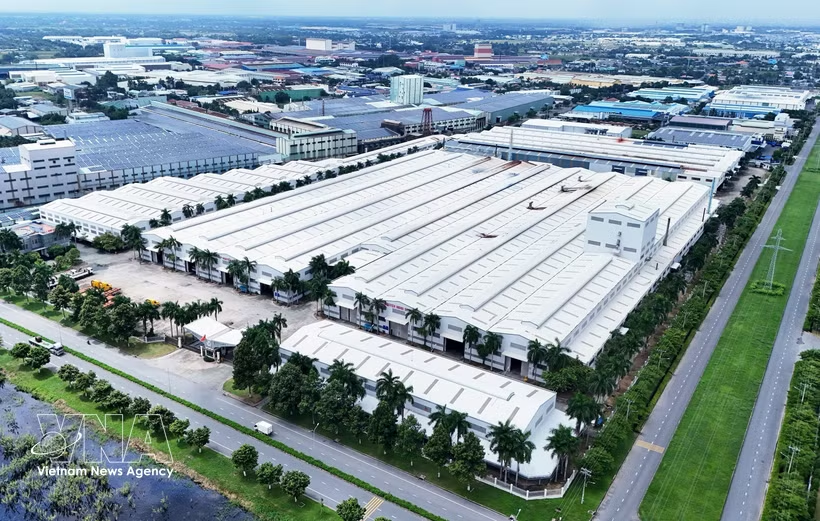
Manufacturing remains a major driver of FDI as international companies diversify their supply chains in Asia. This continues to support demand for industrial land, ready-built factories and customised production facilities.
However, investors are looking beyond location and costs. Power supply, workforce quality, logistics connectivity, ESG standards, expansion potential and the time needed to put facilities into operation are becoming increasingly important.
According to Savills data, roughly two-thirds of new manufacturing investments are tied to projects opting for ready-built factories instead of leasing industrial land.
John Campbell, Director of Industrial Services at Savills Vietnam, said Vietnam’s industrial real estate is entering a new phase where competitive advantage no longer lies in land bank size, but in infrastructure readiness, operational capability and the ability to serve high-value industries.
Demand therefore extends beyond assembly plants to
capable of integrating full supply chains, from component manufacturing to logistics and technical services. Parks located near production hubs, seaports and major industrial corridors are benefiting significantly.
As transport infrastructure expands, areas outside traditional manufacturing hubs are also gaining opportunities to attract industrial, logistics and supply-chain projects.
Campbell said flexibility and strategic accessibility are becoming key criteria in site selection. Areas with strong infrastructure links, access to supply chains and room for expansion therefore have greater potential to attract new investment.
The shift towards high-tech industries is creating another category of specialised real estate demand. Electronics, semiconductors, data centres and other technology-intensive industries require higher standards for power supply, data connectivity, technical infrastructure and uninterrupted operations.
Data centres are a notable example. According to the Savills Vietnam Industrial Outlook 2026, the total operational design capacity of data centres in Vietnam stood at about 524.7 MW in 2025 and is forecast to reach 950 MW by 2030, an increase of about 81%.
This growth is not simply creating demand for more floor space. Large data centres require stable electricity, telecommunications connectivity, high technical standards and continuous operations, creating a specialised property segment that differs considerably from conventional industrial facilities.
Campbell said the growth of e-commerce, data centres and high-tech manufacturing is reshaping industrial real estate demand. These sectors need not only space but also reliable power, advanced infrastructure and high operational standards.
Infrastructure development is also expanding the geographical scope of investment. In northern Vietnam, Hai Phong, Bac Ninh, Hung Yen, Quang Ninh and neighbouring areas are developing increasingly interconnected manufacturing and logistics networks. In the south, Ho Chi Minh City, Dong Nai and areas around Long Thanh are benefiting from major infrastructure projects./.

VIETNAM CHAMBER OF COMMERCE AND INDUSTRY
Liên Đoàn Thương Mại Và Công Nghiệp Việt Nam