VIETNAM CHAMBER OF COMMERCE AND INDUSTRY
Liên Đoàn Thương Mại Và Công Nghiệp Việt Nam
Tue, Aug 20, 2024, 14:10:00
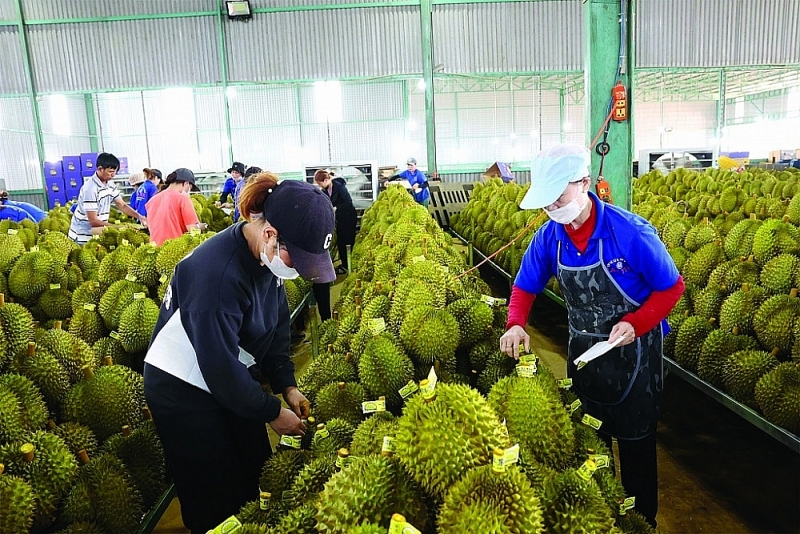 Durian is also on the list of products that the EU proposes to reduce the MRL of Zoxamide from 0.02ppm to 0.01ppm. Illustration photo: VNA
Accordingly, depending on the product, the EU has proposed increasing or decreasing the maximum residue limits (MRLs) of certain active substances. Notably, the EU has proposed changes to the MRLs of several active substances in many Vietnamese agricultural products for export, such as avocados, bananas, mangoes, papayas, durian, okra, tea, coffee, pepper, rice, cashews, and macadamia nuts.
Specifically, for Zoxamide, the EU has proposed reducing the MRL in lettuce, spinach, and Swiss chard from 30ppm to 0.01ppm (equivalent to 3,000 times). For tea and coffee, the EU also proposed reducing the MRL of Zoxamide from 0.05ppm to 0.01ppm...
In addition to Zoxamide, the EU has also proposed changing the MRLs of three other active substances: Fenbuconazole, Penconazole, and Acetamiprid, in products such as peanuts, cashews, macadamia nuts, avocados, bananas, mangoes, papayas, pineapples, guava, durian, cucumbers, zucchini, melons, pumpkins, watermelons, cauliflower, asparagus, tomatoes, and chili peppers... in Vietnam.
According to Mr. Ngo Xuan Nam, Deputy Director of the Vietnam SPS Office, the change of MRLs of the four active substances: Zoxamide, Fenbuconazole, Penconazole, and Acetamiprid, affect many Vietnamese agricultural and food products that are currently being exported to the EU market. Therefore, the Vietnam SPS Office requests research agencies to provide feedback and inform relevant organizations and individuals to control MRLs in accordance with EU regulations.