VIETNAM CHAMBER OF COMMERCE AND INDUSTRY
Liên Đoàn Thương Mại Và Công Nghiệp Việt Nam
Fri, Aug 29, 2025, 01:51:00
Touted as a strategic project, it aims to become a new tourism symbol for Vietnam’s Central Highlands, said Chairman of the provincial People’s Committee Pham Anh Tuan on Sunday.
Gia Lai, a Central Highlands province, was recently merged with the south-central coastal province of Binh Dinh to form the new Gia Lai.
A new tourism hub in the making
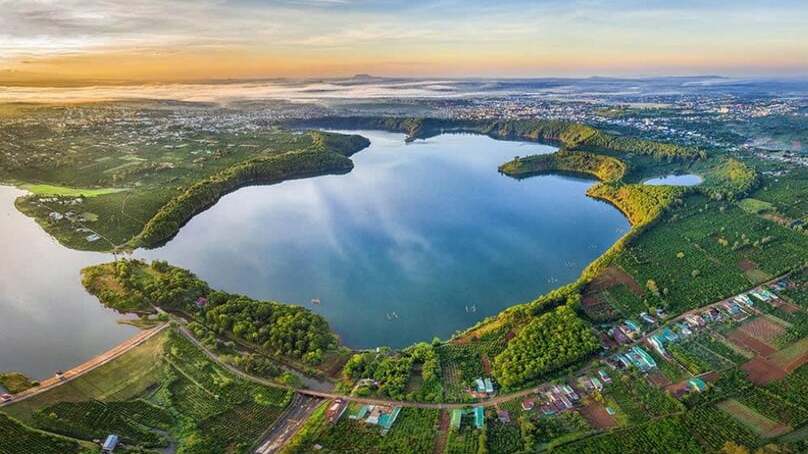
Tuan confirmed the province has officially approved the planning task for the Bien Ho-Chu Dang Ya tourism complex, with a vision to 2050.
Located across Bien Ho commune and Thong Nhat ward, the project area is flanked by the Chu Man mountain range, National Highway 14, and key regional transport routes.
Investment in this project is not only intended to leverage natural resources but also to create a breakthrough in Gia Lai's economic structure, with tourism being positioned as a spearhead sector alongside agriculture and processing.
The project will be divided into five main zones: Bien Ho spiritual-cultural tourism area, Chu Dang Ya tourism service urban zone, Bien Ho tea tourism area, Northern Pleiku gateway urban area, and Bien Ho A ecological urban area.
The planning phase will cost more than VND6.44 billion ($244,620), including over VND3.1 billion for planning and VND1.3 billion for concept competitions. Completion is expected by October 2025, followed by investor promotion and project rollout.
Bien Ho, often called the “Eyes of Pleiku” or “Gia Lai’s emerald gem,” is renowned for its vast lake and biodiversity. Nearby, the extinct volcano Chu Dang Ya draws crowds every November with blooming wild sunflowers - closely tied to local Jrai and Ba Na traditions and the region’s celebrated gong culture.
The combination of unique natural landscapes with the Central Highlands’ gong culture offers a rare competitive advantage, giving the project the potential to reach international prominence.
A new symbol of the Central Highlands
Despite its great potential, the provincial leader acknowledge that the Bien Ho-Chu Dang Ya area still faces many limitations, especially in transportation infrastructure and unstable water resources in the northern and northeastern zones, which could impact the ecosystem.
“This highlights the need for planning to be accompanied by technical solutions, environmental protection measures, and water resource management to prevent unchecked development from harming the environment,” he noted.
Furthermore, for the project to be effective, Gia Lai must consider regional connectivity strategies. Bien Ho-Chu Dang Ya cannot stand alone but must be linked with other destinations in the Central Highlands and central regions, forming a diverse tourism product chain to increase tourist stay duration and spending, he added.
According to Tuan, Bien Ho-Chu Dang Ya is an exceptionally valuable resource area, holding significance not just for the province but for the whole country. Therefore, he emphasized that planning must be conducted methodically, with in-depth research, ensuring harmony between landscape and heritage conservation and tourism-economic development.
With its 6,300-hectare scale and long-term vision as well as the involvement of capable investors, this project is expected to become a new highlight on Vietnam’s tourism map.
Beyond enhancing Gia Lai's brand, Bien Ho-Chu Dang Ya could serve as a "magnet" for international visitors, generating sustainable income for the locality and creating more job opportunities for local communities.
As the Central Highlands seeks new drivers for development, the planning of the Bien Ho-Chu Dang Ya tourism area is a vital step for Gia Lai to efficiently leverage its natural and cultural resources, transforming them into economic value and asserting its position on both the domestic and international tourism maps, he stated.