VIETNAM CHAMBER OF COMMERCE AND INDUSTRY
Liên Đoàn Thương Mại Và Công Nghiệp Việt Nam
Fri, Feb 13, 2026, 11:58:00
Vietnam’s central province of Gia Lai has pledged to work with Swedish textile recycling giant Syre to resolve hurdles related to direct renewable power purchases, as the company advances plans for a large-scale polyester recycling complex designed to run entirely on clean energy.
Speaking at a recent provincial conference on accelerating industrial park development, Wrood Ode, Syre’s global procurement and new product introduction manager, said the company is moving ahead with the project and has committed to sourcing 100% renewable electricity.
 A Syre T-shirt made outside Vietnam. Photo courtesy of the company.
Syre is seeking greater clarity on Gia Lai’s renewable energy development pipeline, as well as roadmaps and guarantees for green power supply to support long-term operations, Ode said.
Gia Lai has emerged as one of Vietnam’s key renewable energy hubs, particularly for wind and solar. The provincial Department of Industry and Trade said 86 renewable energy projects are currently operational in the province, with a combined installed capacity exceeding 4,300 megawatts.
In 2025, the province generated about 15 billion kilowatt-hours of electricity, far exceeding local demand of roughly 4.5 billion kilowatt-hours, leaving a large surplus fed to the national grid.
Between 2026 and 2030, total power supply is expected to increase to about 1.3 times current levels, as renewable projects continue to attract export-oriented manufacturers seeking access to clean electricity.
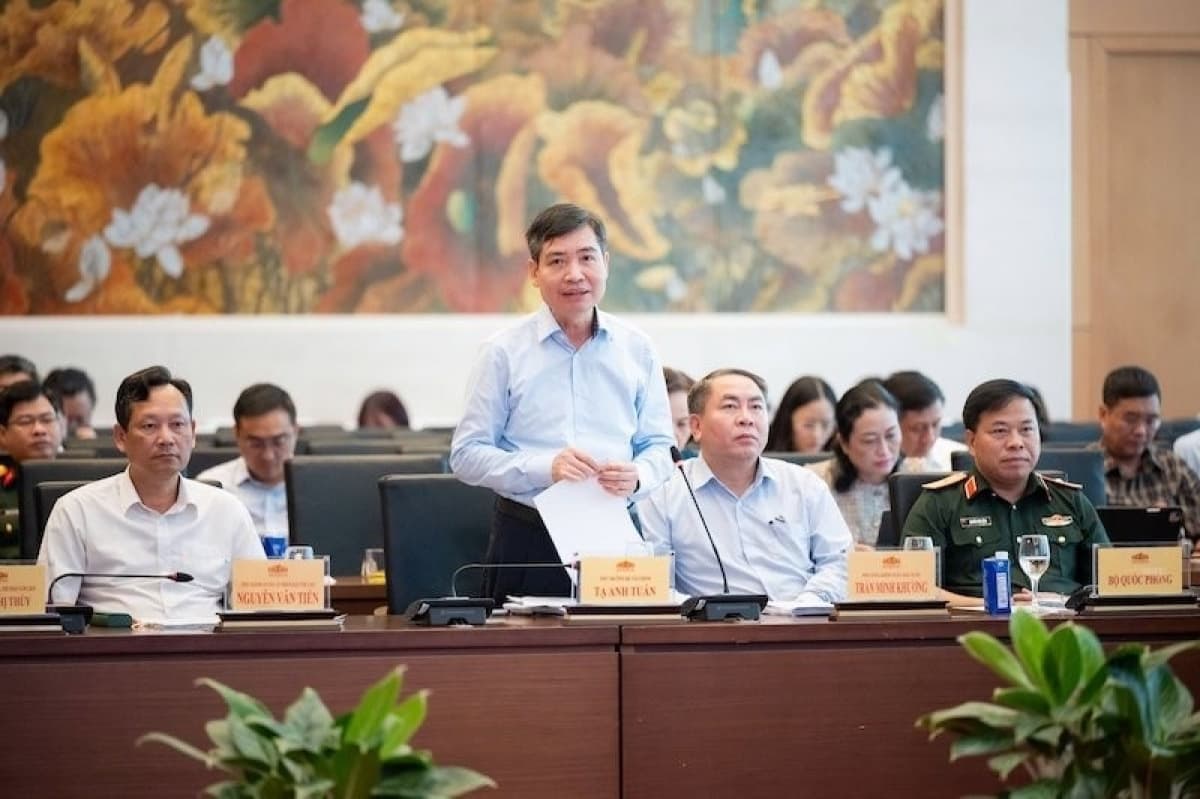
 Wrood Ode (left), Syre’s global procurement and new product introduction manager, at a conference in Gia Lai province, central Vietnam. Photo courtesy of Dau Tu (Investment) newspaper.
Provincial officials acknowledged, however, that direct negotiations between renewable power producers and large industrial users have historically been difficult, as generators have tended to favor selling electricity to the national grid for revenue stability rather than entering bilateral contracts.
That constraint has eased following the government’s issuance of Decree 57 on March 3, 2025, which establishes a legal framework for direct power purchase agreements (DPPA) between renewable energy producers and large consumers.
Under the new mechanism, buyers can procure renewable electricity either through dedicated transmission lines or via the grid operated by state utility Vietnam Electricity (EVN), subject to commercial agreements.
Gia Lai authorities said the province is currently rolling out renewable projects with total capacity of more than 4,000 megawatts, providing sufficient supply for large industrial users, though investors may need to negotiate directly with power plants to secure tailored arrangements.
The Department of Industry and Trade said it has been working with project consultant Houselink, and that an investment plan for a dedicated power supply for Syre is expected to be announced at Gia Lai’s investment promotion conference in late March 2026.
Nguyen Tu Cong Hoang, Vice Chairman of the Gia Lai People’s Committee, said bidding results have already been announced for a 750 MW renewable project near Syre’s planned site – the Hon Trau Wind Power Project (phase 1), helping ensure access to clean electricity.
“Investors can be confident that we will work with them and with power producers to reach a direct power purchase agreement,” Hoang said, adding that issues related to plant location, transmission lines, and commercial terms would be jointly addressed.
According to documents previously submitted to provincial authorities, Syre’s total electricity demand could reach 200 MW by 2050 if wind power is included.
In the first phase, by 2028, the company expects 20-30% of its power demand, or around 60 MW, to be supplied through direct power purchase agreements using dedicated lines. That share is projected to rise to 50% by 2040 and reach 100% by 2050.
The recycling complex, with an estimated investment of $1 billion, is expected to operate continuously, with estimated electricity consumption of about 1.6 gigawatt-hours per day, or roughly 563 gigawatt-hours per year.
In addition to wind power, Syre plans to install rooftop solar panels with a capacity of about seven MW, accounting for around 5% of total demand.
Separately, Syre said it is still in the process of securing permits to import used textiles, a key input for the polyester recycling operation.