VIETNAM CHAMBER OF COMMERCE AND INDUSTRY
Liên Đoàn Thương Mại Và Công Nghiệp Việt Nam
Mon, Nov 10, 2025, 14:18:00
Vietnam will build one international financial center (IFC) located in both Danang and Ho Chi Minh City, with unified management and development of separate products based their own strengths, according to a resolution adopted by the country’s legislature in June.
HCMC in the south is the country's biggest economic hub, while Danang is the heart of the central region in terms of economic and tourism aspects.
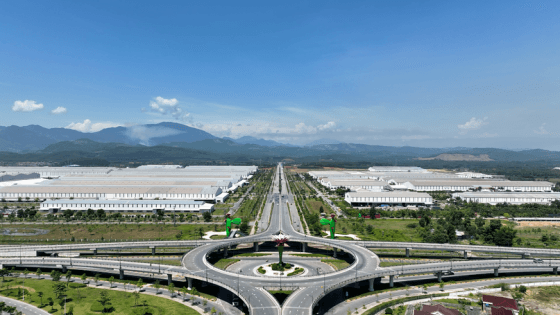
 A view of Danang city, central Vietnam. Photo by Thanh Van/The Investor.
Speaking at a Thursday seminar on the IFC, Ho Ky Minh, Standing Vice Chairman of the Danang People’s Committee, said that the center in Danang will be developed on three main pillars: green finance, trade finance, and fintech, with a focus on digital assets.
Apart from the ‘laboratory’, Danang plans to boost fund management activities to support fintech startups, he noted.
At the same time, the city will promote green finance products and initiatives to support Vietnam’s net-zero goals and global sustainability vision, utilizing its strengths in renewable energy and sustainable tourism, Minh continued.
Danang also aims to develop cross-border trade finance linked to its seaports, logistics, and international tourism, along with offshore financial services for organizations, foreign-invested enterprises, and global investors.
The city is particularly focused on fostering a favorable financial environment for small and medium-sized enterprises (SMEs) and innovative startups. This aims to build a diverse, dynamic, and creative financial ecosystem grounded in the core values of sustainability, intelligence, digitalization, innovation, inclusiveness, and customer centricity - all geared toward improving quality of life, the official noted.
To that end, he said, the city has consulted and coordinated with ministries and agencies to complete the legal framework and draft decrees related to the IFC, which are expected to be submitted to competent authorities for approval before November 15.
Solution to economic growth puzzle
Rich McClellan, from the Advisory Council at Vietnam International Financial Center (Danang), said establishing the center is not merely a strategic choice but an inevitable step as the country’s production- and export-driven growth model approaches its limits.
After more than three decades of remarkable growth, Vietnam needs a new, more sophisticated driver linked to the global financial ecosystem, he said, stressing the IFC offers the solution.
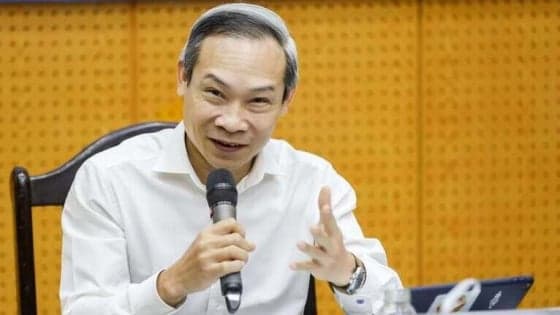
 Rich McClellan, from the Advisory Council at Vietnam International Financial Center (Danang), speaks at a seminar on such a center in Danang city, central Vietnam on November 6, 2025. Photo courtesy of Danang newspaper.
The expert explained that the first driver is economic. Vietnam has only about three to five years of leeway under its traditional growth model. To move into a higher stage of development, the country must shift from a manufacturing-based economy to a finance and services economy, where capital, technology, and knowledge become the primary engines of growth.
The second factor is geopolitical. The world is experiencing major upheavals, with the economic order shaped by strategic competition and trade barriers. Vietnam, with its neutral stance and extensive FTA network, is emerging as a reliable destination. The IFC will enable the country not only to sell goods but also to trade financial products, enhancing the economy’s resilience.
According to McClellan, Dang was chosen for its comprehensive infrastructure, including a deep-water port system, international airport, free trade zone, software park, and high-tech zone. It is also among Asia’s most livable cities, capable of attracting high-quality talent and international experts.
The IFC in Danang is expected to advance green finance and fintech, and support small and medium-sized enterprises - sectors with strong potential to fuel the next wave of the digital economy.
He added that the next stage requires moving from policy formulation to practical implementation: finalizing legal frameworks, organizational models, one-stop licensing procedures, infrastructure, and personnel, while especially attracting strategic investors. Vietnam also needs a robust IFC branding strategy strong enough to send a clear message to the world.
Despite numerous challenges, the IFC is viewed as a new growth model that could help Vietnam move beyond the limits of a manufacturing-based economy and enter the ranks of developed nations within the next 15 years, he added.
A resolution on the development of an IFC in Vietnam was passed by the National Assembly, the country’s legislature, on June 27. Accordingly, Vietnam will build one IFC located in both HCMC and Danang,
The section in HCMC will house capital markets, banks, currency markets, testing mechanisms (sandboxes) on fintech, innovation in the financial sector, specialized trading floors, and new trading platforms.
The Danang section will develop green finance, apply financial technology, and promote digital services. The city will also test digital assets and digital currencies under control; promote payments; and attract investment funds, remittance funds, and small and medium-sized fund management companies.
Danang targets double-digit economic expansion for the year. To date, the city has attracted 1,282 FDI projects with total registered capital of over $10.96 billion.
In August 2025, the Danang People’s Committee established the Advisory Council for the Development of Vietnam’s International Financial Center, bringing together numerous experts, banking leaders, and domestic and international businesses.
The council is tasked with conducting research and providing advice to the city’s leadership and IFC regulators on the development strategy; governance model; incentives for the center in terms of finance, land use, legal and support services, as well as training programs for high-quality human resources; and policies to attract global experts and overseas Vietnamese professionals.
At a recent national meeting on establishing the IFC, Prime Minister Pham Minh Chinh instructed relevant agencies to urgently finalize a government decree to enable the financial center to begin operations within November.