VIETNAM CHAMBER OF COMMERCE AND INDUSTRY
Liên Đoàn Thương Mại Và Công Nghiệp Việt Nam
Mon, Sep 01, 2025, 10:22:00
The Civil Aviation Authority of Vietnam (CAAV) has submitted a proposal to the Ministry of Construction on the airport’s master plan for 2021-2030, with a vision to 2050, according to the government’s news portal.
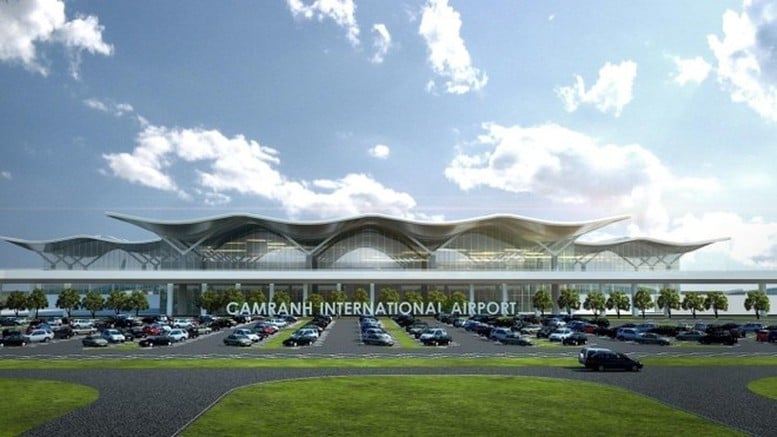 Cam Ranh International Airport in Khanh Hoa province, central Vietnam. Photo courtesy of the government's news portal.
For 2021-2030, Cam Ranh International Airport is classified as a level-4E civilian airport - capable of handling aircraft with a reference field length of 1,800 meters or more and wingspans up to 65 meters - and also designated as a level-I military airbase, with an annual cargo capacity of 50,000 tons.
It will accommodate aircraft including B747, B777, B787, A321, A350 and equivalents or smaller, with precision landing systems meeting Category II (CAT II) standards.
According to the International Civil Aviation Organization (ICAO), CAT II operation is a precision instrument approach and landing with a decision height lower than 60 meters (200 ft), but not lower than 30 meters (100 ft); and a runway visual range not less than 350 meters.
The plan includes expanding the apron to 61 stands - 44 Code C for A320/B737s and equivalents, and 17 Code E for A330/B787s and equivalents - and building a new T1 terminal with a 21-million-passenger capacity, while retaining the existing T2 international terminal at 4 million.
The airport is also planned with a cargo terminal area covering more than 3 hectares.
By 2050, it is projected to handle 100,000 tons of cargo annually, maintaining CAT II precision landing systems for the above-said aircraft. The apron will grow to 86 stands - 61 Code C and 25 Code E.
The T1 terminal will expand to 32 million passengers annually, while the existing T2 international terminal remains at 4 million.
In addition, the cargo terminal will be enlarged toward the T2 terminal, with room for long-term growth.
Notably, the CAAV has proposed a general and private aviation zone at the airport, covering about 9,610 square meters, with a general aviation apron of roughly 41,500 square meters.
Total land demand for 2021-2030, with a view to 2050, is estimated at over 628 hectares, including nearly 588 hectares under civil aviation and more than 40 hectares under military control.
Under a master plan approved in 2009, Cam Ranh International Airport was projected to handle 5.5 million passengers annually by 2020, with a target of 8 million by 2030.
In practice, however, it served more than 9.7 million passengers in 2019, just before the Covid-19 pandemic, and nearly 7 million in 2024.
On July 1, Khanh Hoa and its neighboring Ninh Thuan were merged to form the new Khanh Hoa province.