VIETNAM CHAMBER OF COMMERCE AND INDUSTRY
Liên Đoàn Thương Mại Và Công Nghiệp Việt Nam
Tue, May 12, 2026, 11:32:00
Speaking at a seminar on the banking sector’s role in supporting economic growth last Friday, Quang said policymakers are facing unprecedented challenges as they seek to balance inflation control, macroeconomic stability and support for long-term growth.
In the context of persistent global uncertainty, Vietnam’s monetary policy space has narrowed while pressure from exchange rates, global interest rates and inflation expectations has intensified.
According to Quang, current policy pressure stems from unpredictable developments in the global economy and financial markets, particularly geopolitical tensions in the Middle East, which have kept oil prices and global inflation elevated.
Citing data from the International Monetary Fund, Quang said the IMF has raised its global inflation forecast by 0.6 percentage points to around 4.4%, above the actual 2025 level of 4.1%.
As a result, many central banks have maintained cautious policy stances, contributing to greater volatility in global interest rates, exchange rates and capital flows, he said. “Even the Fed has significantly adjusted its interest rate direction recently,” the official added.
He noted that as a highly open economy, Vietnam remains vulnerable to external shocks, which could quickly transmit into domestic markets and place pressure on exchange rates, interest rates and inflation expectations.
At the same time, Vietnam is targeting double-digit economic growth not only for 2026 but also over the next five years, an ambitious goal as the economy continues to face inflationary and macroeconomic pressures.
“This is a dual objective often described in policymaking as the ‘impossible trinity’,” Quang said.
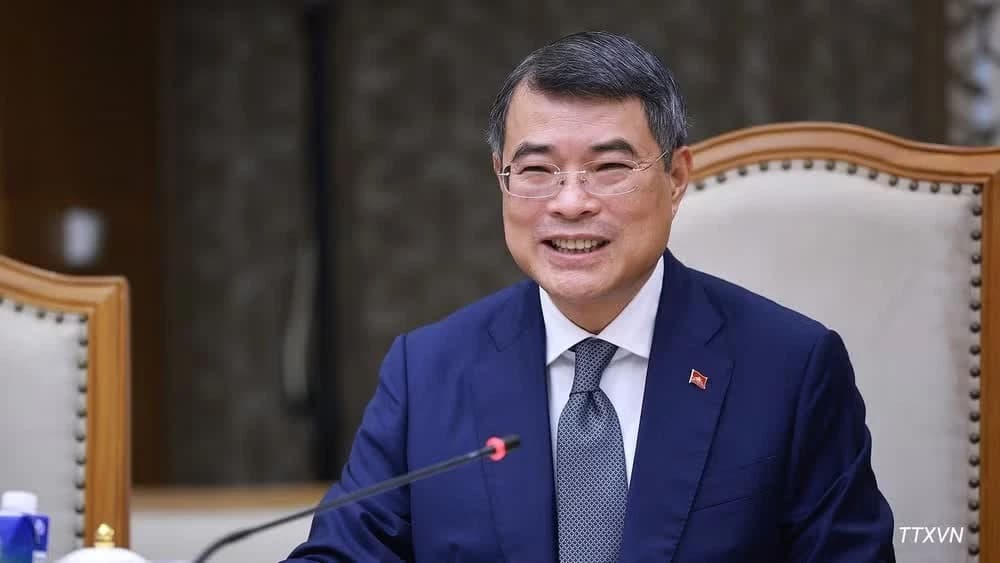
 Pham Chi Quang, head of the State Bank of Vietnam's monetary policy department, speaks at a seminar on the banking sector’s role in supporting economic growth in Hanoi, May 8, 2026. Photo by The Investor/Dinh Vu.
According to Quang, monetary policy management now requires not only flexibility but also close coordination with fiscal policy and other macroeconomic measures to maintain a balance between growth and stability.
Quang said one of the biggest challenges facing policymakers was market expectations, particularly regarding exchange rates and inflation, which could strongly influence market sentiment in Vietnam.
“To anchor market expectations, it is essential to maintain macroeconomic stability, control inflation effectively and conduct policy proactively, flexibly and in a timely manner to avoid shocks to the economy,” he said.
Looking ahead, Quang said the State Bank of Vietnam’s (SBV) overarching goals remained inflation control, macroeconomic stability and supporting growth within the limits allowed by monetary policy.
He added that high growth would need to come from innovation, science-technology and improvements in labor productivity. In that framework, fiscal policy would play the leading and expansionary role, while monetary policy would act as support.
“Monetary policy will support and complement fiscal policy in anchoring expectations for inflation control and macroeconomic stability,” he said.
On interest rate management, Quang noted the central bank had implemented a range of coordinated measures to support liquidity and create conditions for lower lending rates.
Interest rates are a key component of corporate operating costs, and lower borrowing costs would help improve the competitiveness of businesses and the broader economy, he said.
Since 2023, the SBV has maintained stable policy rates to support overall market rates and enable lenders to access lower-cost funding.
At the same time, the central bank has used open market operations to inject significant liquidity with maturities of up to two months to stabilize market liquidity conditions. According to Quang, the aim was to transmit lower rates from the interbank market to the broader deposit market.
The central bank has also conducted foreign exchange swap operations to provide additional Vietnamese dong liquidity to credit institutions.
Notably, from the end of the first quarter of 2026, it issued directives requiring lenders to stabilize interest rates, restructure funding sources and better balance deposit mobilization and lending activities.
On April 9, the central bank governor and senior officials met with representatives from Vietnam’s 46 largest commercial banks to discuss measures to lower interest rates. Following the meeting, nearly all banks agreed to cut deposit rates for maturities of six to 12 months by between 0.1 and 1 percentage point annually.
According to official data, the average rate on newly generated deposits currently stands at around 5.7%, down about 0.26 percentage points from the end of March 2026. “Average lending rates have also begun to show a slight downward trend,” Quang said.
"If lower deposit rates continue feeding through into banks’ funding structures, lending rates will have further room to decline in the coming period. We are fully confident that lending rates will continue to decrease to support the economy,” he added.
However, Quang stressed that lower interest rates must go hand in hand with exchange rate stability and maintaining the attractiveness of the Vietnamese dong. The central bank would therefore continue managing policy flexibly and maintaining a reasonable interest rate differential between the dong and the U.S. dollar to limit dollarization in the economy.
Regarding credit growth, the SBV is targeting credit expansion of around 15% while directing capital flows toward priority sectors and key economic growth drivers, alongside tighter controls over high-risk sectors to ensure financial system safety.