VIETNAM CHAMBER OF COMMERCE AND INDUSTRY
Liên Đoàn Thương Mại Và Công Nghiệp Việt Nam
Wed, Sep 10, 2025, 07:44:00
Such a shift in urban development dynamics was the key focus of a Saturday forum titled “Coastal Cities Near International Airports – A New Investment Heartbeat for Hanoi”.
The rise of airport cities
The "airport city" model is rapidly gaining global traction. It serves as the central core, surrounded by economic corridors and clusters that include aviation-related businesses, commercial-service sectors, and residential-workplace areas.
All those components are closely interconnected thanks to the airport’s direct and convenient connectivity, forming a synchronized and integrated development ecosystem.
The rapid expansion of commercial activities around airports is transforming these aviation "gateways" into airport-adjacent urban areas where international travelers and local residents can work, do business, shop, and enjoy entertainment, all within a 15-minute radius from the airport.
Major global urban centers like Incheon (South Korea), DXB and DWC (Dubai), Changi (Singapore), and Zhengzhou Xinzheng International Airport (China) have already proven the viability of this model.
According to Dr. Bui Van Doanh, director of the Vietnam Institute of Real Estate Research (VIRER), the country is well-positioned to replicate this success.
"Vietnam currently has 10 international airports, with Noi Bai, Tan Son Nhat, and Cam Ranh already meeting international standards. As cities like Hanoi and Ho Chi Minh City reach peak urbanization, population and investment are flowing toward surrounding satellite cities. Previously, airports followed cities. Now, cities are following airports,” Doanh emphasized.
Cam Ranh: A prime example
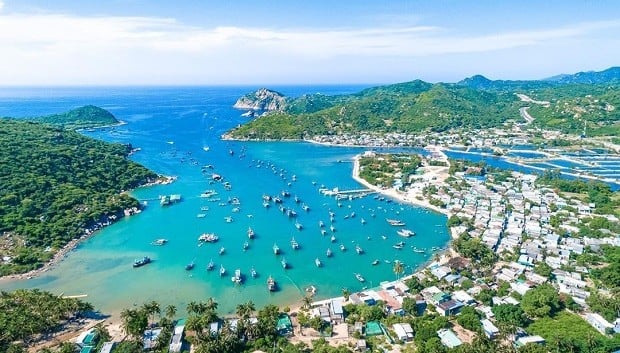
Cam Ranh, located in the south central province of Khanh Hoa, is emerging as a strong candidate for Vietnam’s next airport city. The international airport is certified at ICAO 4E level, capable of handling large aircraft like the Boeing 747 and Airbus A350. Passenger capacity is projected to hit 25 million by 2030 and 36 million by 2050.
The locality also boasts natural advantages, including Bai Dai - named by Forbes as one of the world’s most beautiful beaches. Coupled with high connectivity via the Ho Chi Minh City-Khanh Hoa Expressway, and the upcoming Khanh Hoa-Buon Ma Thuot and Da Lat-Khanh Hoa expressways and high-speed railways, and access to a deep-sea port, Cam Ranh offers a rare convergence of air, sea, and land infrastructure.
“Cam Ranh isn't just sunshine, white sand, and blue seas,” Dr. Doanh noted. “Unlike Van Don in Quang Ninh province or even Phu Quoc in An Giang province, which have tourism appeal but lack long-stay options, Cam Ranh has the space, infrastructure, and attractions to become a true second-home destination.”
From trend-based to value-based investment
Architect Truong Van Quang observed that in many countries, airports have become central hubs within metropolitan regions, with surrounding areas developing a diverse range of industrial centers, commercial services, logistics, and residential zones.
Airport-adjacent cities are urban areas planned with synchronized infrastructure and amenities, where the airport serves as the core driver of investment and development.
Thanks to the successful planning and development of these cities, many developed countries such as the United States, the Netherlands, South Korea, and Singapore have created new urban growth poles in finance, tourism, import-export, logistics, education, and health care, offering significant competitive advantages in the age of global connectivity.
Meanwhile, Associate Professor Dr. Tran Dinh Thien, former head of the Central Institute for Economic Management (CIEM), noted that Cam Ranh possesses many factors conducive to becoming a “seaport and airport city” and should aim to become a model like Danang - a destination that is both attractive to visit and livable.
Speaking further on the capital shift towards the southern region, Thien affirmed that there is a solid foundation for this trend. From Khanh Hoa southward, the region not only boasts rare natural resources but is also favored by a pleasant climate, with over 300 sunny days per year - an exceptional advantage for the development of tourism and high-end resorts.
At the same time, the area is attracting investment capital from international investors, like those from South Korea, and potentially from countries like Russia in the future.
Dr. Nguyen Van Dinh, chairman of the Vietnam Association of Real Estate Brokers (VARS), stated that the Vietnamese market is currently witnessing a trend of investors moving southward in search of higher-quality, legally-compliant investment products.
"Clearly, investors are no longer following trends or fads, as they now recognize the significant risks associated with such behaviors. Instead, they are increasingly aware that capital utilization must be effective and ensure long-term, sustainable returns," he argued.