VIETNAM CHAMBER OF COMMERCE AND INDUSTRY
Liên Đoàn Thương Mại Và Công Nghiệp Việt Nam
Mon, Dec 18, 2023, 14:29:00
Minister of Information and Communications Nguyen Manh Hung at a forum on Vietnam’s digital tech businesses last week announced that 2024 will be the year of 5G commercialisation across the country to create infrastructure for digital industrial applications.
The statement reflected the strong determination of the Vietnamese government in 5G commercialisation to support its digital transformation, with delays besetting the rollout for several years. Now, 5G commercialisation will be backed by the amended Law on Telecommunications, which was adopted by the National Assembly in November and will come into effect from July 2024.
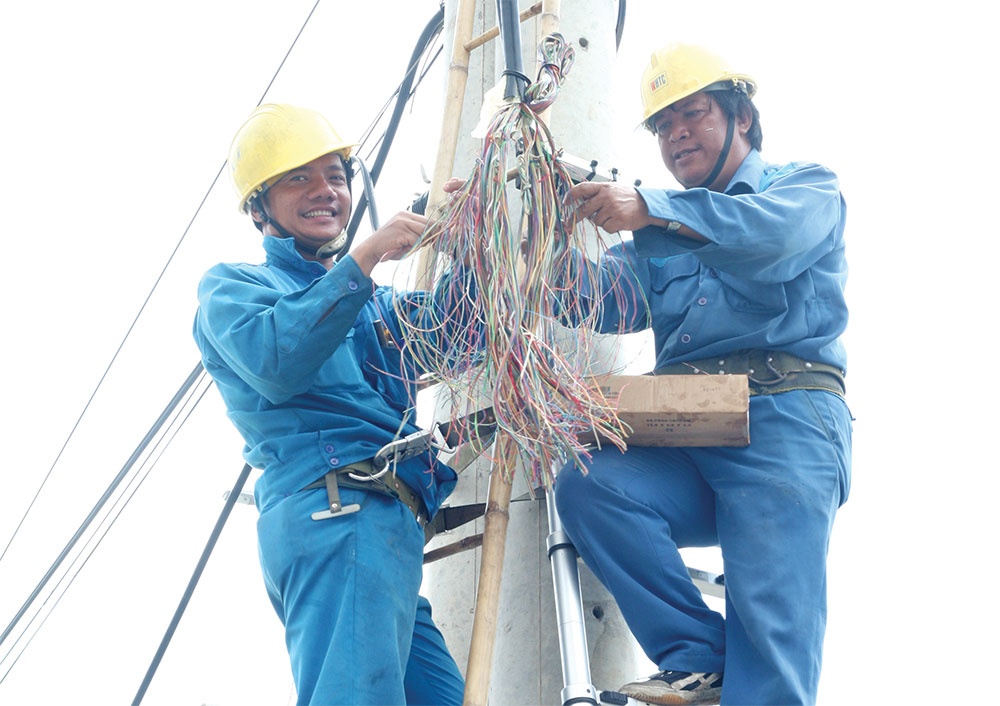
| Far-reaching 5G deployment is around the corner, photo Le Toan |
The law has regulations to create better conditions for the development of telecommunications infrastructure. It allows telecoms works to be built and installed in public assets; increases sharing of infrastructure among telecoms sector and other technical infrastructure works; and adds responsibilities to investors of residential areas, public works, and functional works for making space ready for construction and installation of telecoms infrastructure.
Nguyen Tien Sy, deputy head of the Hanoi Department of Information and Communications, said, “The amended Law on Telecommunications allows network operators to build BTS stations on public land. This is a new point that helps network operators build stations across the country.”
The law also supplements a regulation on responsibilities of the people’s committees and relevant ministries and agencies for dealing with barriers to construction of legal telecoms infrastructure.
A representative of the Authority of Radio Frequency Management told VIR, “Currently, the 2600 MHz band is being auctioned. Enterprises must provide services no later than 12 months after being licensed. After the 2600 MHz auction, the Ministry of Information and Communications will soon continue to auction the 3700 MHz band to promote 5G deployment.”
Mobile network operators are now preparing for the important period next year. Ngo Dien Hy, deputy general director of VNPT Group, emphasised that frequency band auction is a prerequisite for commercialising 5G.
“When joining frequency band auctioning, network operators must develop a careful investment plan to limit excessively high infrastructure costs. Because if they make big investment to commercialise 5G on a large scale, but there is no demand from customers, the efficiency will not high,” Hy said.
Le Ba Tan, technical head at Viettel, added, “I believe that the licensing of 5G commercialisation will be carried out quickly and at an appropriate cost. This is a sufficient condition for network operators to auction to deploy 5G.”
Nevertheless, there are still some concerns about the amended law. Hoang Viet Tien, head of Strategic Advisory of online media company Insider said, “Licensing for businesses currently has only one form of licensing and the same process and procedures for all types of licences. It does not yet classify them according to the nature and characteristics of each type of network and telecommunications service, and licensing conditions such as legal capital and investment commitment of a specific amount are no longer appropriate.”
5G commercialisation in Vietnam has been long expected among major businesses that are ready to support the country.
Ericsson currently powers 155 live 5G networks across 66 countries. In Vietnam, Ericsson has made contributions to Vietnam’s socioeconomic development and prosperity since 1993 through the mobile communication and broadband connectivity it has provided via the supply and installation of 2G-4G. It has also been supporting service providers in Vietnam with commercial 5G pilots since 2020.
Elsewhere, to secure Vietnam’s 5G future, Nokia has designed ReefShark chipsets, especially for 5G network solutions. These chipsets embed quality, performance, and efficiency to help open communication services providers (CSPs), and let customers take advantage of a world of business opportunities that 5G will bring.
Rubén Moron Flores, general manager of Nokia Vietnam, said, “We have been working with the country’s leading CSPs to help lay the foundations for sustained 5G growth by establishing base stations and forming collaborative ventures. We are cooperating with a local CSP to prepare the groundwork for the country’s ports, as well as homes and businesses, for wide-scale adoption.”